

Payroll in California

Payroll services for California businesses.

Visory provides payroll services for California businesses with staff across the state. A dedicated Payroll Specialist runs each pay run remotely in your own payroll platform, handling state withholding, the State Disability Insurance deduction, city minimum wages, and the notice every new hire needs. Delphi AI takes the repetitive parts, overseen by the team. You approve each run before anyone is paid. One flat monthly fee.

  • A dedicated team you know by name
  • California rules in every pay run and close
  • One flat monthly fee for the agreed scope
The California State Capitol in Sacramento, its white dome above flowering gardens and cedars under a clear blue sky.
Photo: Earthquakesurprise, CC0

Payroll in California

What every California pay run covers.

A dedicated team prepares each pay run, checks it, and sends it to you to approve before anyone is paid. Six things are right every time.

  • Withholding, every run Federal withholding, and state and local taxes where they apply, worked out in every run from each employee’s own forms.
  • Filed on schedule Quarterly and annual payroll tax filings prepared from the same runs and filed on schedule by your payroll platform, so nothing is rebuilt at the deadline.
  • Unemployment insurance California contributions worked out on each employee’s wages, up to the state’s taxable wage base.
  • Leave that adds up Paid leave accrued in the file to the state’s rules, so balances are right when someone asks.
  • Paid on the right day Pay frequency and final pay set to the state’s rules, and every run approved by you before anyone is paid.
  • New hires, set up properly New employees reported to the state and set up before their first pay run.

California rules

The California rules every pay run works to.

Eight rules set by California, each with the law that sets it and what it does to your month. Your team works to them every pay run and every close.

Withholding leaves with every payroll.

An employer on a semi-weekly federal schedule deposits California tax and the disability insurance deduction within days of payday, and the quarterly DE 9C has to agree with every deposit, so payroll and the books are reconciled each pay run.

Set by California Unemployment Insurance Code; 2026 Withholding Schedules

Employers withhold California personal income tax using the 2026 withholding schedules and each employee’s DE 4 or W-4. In the exact calculation method, rates rise from 1.1% to 14.63% on annual taxable wages above $1 million for a single filer. Bonuses and stock options may be withheld at a flat 10.23%, and other supplemental wages at 6.6%. Deposits follow the federal schedule: next-day or semi-weekly once more than $400 accumulates, monthly by the 15th from $350.

California Unemployment Insurance Code; 2026 Withholding Schedules; 2026 withholding schedules, for wages paid in 2026.

The cost lands early in the year.

Contributions stop once an employee’s wages pass $7,000, so for most salaried staff the year’s unemployment cost accrues on January to March wages and is paid with the first-quarter deposit by April 30, and a budget that spreads it evenly overstates the cost later in the year.

Set by California Unemployment Insurance Code

Employers pay unemployment insurance on the first $7,000 of each employee’s wages a year. New employers pay 3.4% for two to three years; the 2026 schedule is Schedule F+, Schedule F plus a 15% emergency surcharge, with rates from 1.5% to 6.2%. The Employment Training Tax adds 0.1% on the same $7,000. The quarterly DE 9 and DE 9C are delinquent if not filed by April 30, July 31, and November 2, 2026, and February 1, 2027.

California Unemployment Insurance Code; 2026 contribution rates and wage limit (Schedule F+).

Two floors move every January.

The hourly minimum and the exempt salary threshold rise together, so salaries just above $70,304 need checking before the first 2027 payroll, and staff in a city with its own rate are paid the higher one.

Set by California Labor Code, § 1182.12

The state minimum wage is $16.90 an hour for all employers from January 1, 2026, rising to $17.40 on January 1, 2027, after the Department of Finance certified the inflation increase. Exempt employees must earn at least twice the minimum wage for full-time work: $70,304 a year in 2026 and $72,384 in 2027. Employers may not count tips toward the minimum wage, and some cities and counties set higher local rates.

California Labor Code, § 1182.12; $16.90 from January 1, 2026; $17.40 from January 1, 2027.

How the work is delivered decides the tax.

A design or campaign sent only as files is not taxable, while the same work handed over as printed or physical artwork is, so invoices separate the two and the books hold any tax collected apart from revenue.

Set by California Sales and Use Tax Law; CDTFA Publications 73 and 37

California sales tax applies to retail sales of tangible personal property; some labor and service charges are taxable when they are part of the sale of tangible property. Artwork is generally taxable when transferred in tangible form, but work delivered only electronically is not. The statewide rate is 7.25%, and district taxes take combined rates as high as 11.75%. CDTFA assigns a monthly, quarterly, quarterly prepay, or annual return, due the last day of the month after the period.

California Sales and Use Tax Law; CDTFA Publications 73 and 37; combined rates operative October 1, 2026.

Two caps, kept apart.

Employees can use 40 hours or five days a year but may carry a balance of up to 80 hours, so the payroll file tracks the balance and the year’s use separately, and staff in San Francisco or Los Angeles accrue under city rules too.

Set by California Labor Code, § 246

Employers must provide and allow employees to use at least 40 hours or five days of paid sick leave a year. Under an accrual policy, employees earn at least one hour for every 30 hours worked, and an employer may cap total accrued leave at 80 hours or 10 days. Under an up-front policy, the full amount is available at the start of each year. Where a local ordinance requires more leave, the employer provides the higher amount.

California Labor Code, § 246; 40 hours or five days from January 1, 2024.

A termination is a same-day pay run.

Final wages are due at the moment someone is let go, so the final check, with its vacation payout, is calculated before the conversation, not on the next regular payday.

Set by California Labor Code, §§ 201, 202, and 204

Most wages are paid at least twice each calendar month on regular paydays set in advance. Wages earned from the 1st to the 15th are due by the 26th, and from the 16th to month end by the 10th of the next month; weekly or biweekly pay is due within seven calendar days of the period’s end. A discharged employee is paid all wages, including accrued vacation, immediately; one who quits without 72 hours’ notice, within 72 hours.

California Labor Code, §§ 201, 202, and 204.

Onboarding is part of the pay run.

The new-hire report and the pay notice draw on the same setup as the first pay, so both are done the day someone is added to the payroll file, and any later pay change is written up within the week.

Set by California Unemployment Insurance Code (DE 34); Labor Code, § 2810.5

Employers report each newly hired or rehired employee to the EDD’s New Employee Registry within 20 calendar days of the start-of-work date, the first day services are performed, on Form DE 34 or through e-Services for Business. Under the Wage Theft Protection Act, each nonexempt employee also receives a written notice at hire of their pay rates, overtime rates, regular payday, and the employer’s name, and an update within seven days of a change not shown on the next pay stub.

California Unemployment Insurance Code (DE 34); Labor Code, § 2810.5; Labor Code § 2810.5 notice required from January 1, 2012.

The deduction never stops.

With no wage limit, SDI comes out of every paycheck all year, bonuses included, so each employee’s year-end SDI total should equal 1.3% of their wages, and payroll is checked against that before the W-2s go out.

Set by California Unemployment Insurance Code (State Disability Insurance)

Employees fund State Disability Insurance, which provides both Disability Insurance and Paid Family Leave benefits, through a withholding of 1.3% of wages in 2026, up from 1.2% in 2025. Since January 1, 2024, there is no taxable wage limit, so the deduction applies to every dollar of wages. The maximum weekly benefit in 2026 is $1,765. Employers deposit SDI with personal income tax withholding, on the same schedule.

California Unemployment Insurance Code (State Disability Insurance); 2026 SDI rate, from January 1, 2026.

Rules last checked October 9, 2026 against the sources at the foot of this page. General information only. It does not take your circumstances into account.

Local rules

Where the rules change across California.

Your team applies the local rules as well as the California ones. These are the places where a local tax, a wage rate, or a leave law differs from the rest of the state.

San Francisco’s Financial District, with the Transamerica Pyramid and Salesforce Tower, above the city’s hillside streets.
Photo: Nils Huenerfuerst, Unsplash License

San Francisco

San Francisco sets its own minimum wage, a larger sick leave balance, and a health care spending rule for employers with 20 or more workers.

  • Employees performing work in San Francisco, including part-time and temporary staff, are paid at least $19.61 an hour from July 1, 2026, adjusted each year by the Consumer Price Index.
  • Employees earn 1 hour of paid sick leave for every 30 hours worked; employers with 10 or more employees may cap the balance at 72 hours, and smaller employers at 40 hours.
  • Under the Health Care Security Ordinance, employers make required health care spending each quarter for covered employees; from January 1, 2027, the rate is $2.99 an hour with 20 to 99 employees and $4.49 with 100 or more.

Palm trees in front of the downtown Los Angeles skyline, with snow on the mountains behind.
Photo: Jeffrey Clayton, Unsplash License

Los Angeles

The City of Los Angeles raises its minimum wage every July and requires more paid sick leave than state law.

  • Employees who perform at least two hours of work in the City of Los Angeles are paid at least $18.42 an hour from July 1, 2026, up $0.55, adjusted each July by the Los Angeles area Consumer Price Index.
  • Employers provide at least 48 hours of paid sick leave a year, front-loaded or accrued at 1 hour for every 30 hours worked, and carried-over leave may be capped at no less than 72 hours.
  • Employees may use paid sick leave from their 90th day of employment, and an employer need not pay out unused sick leave when employment ends.

How it works from anywhere

Can a team outside California run a California business?

Yes. Visory’s US leadership team is in New York, and its teams work with businesses across the United States remotely, inside your own accounting file, so nothing about the work depends on where your office is.

Your own file

Your books stay in your own QuickBooks or Xero file. Your team works inside it, so you see the same numbers they do, whenever you look.

A team you know by name

A dedicated team runs the work, led by a Business Performance Partner. You meet them by video call, and you always know who to ask.

California rules, built in

Visory runs the finance function for growing businesses across the United States, with its US leadership team in New York. Your books stay in your own QuickBooks or Xero file, and your team works inside it with you. Every pay run and every close is checked against the rules on this page.

Business hours, and the platform after them

Your team works 9am to 5pm Eastern Time on business days, all year round, and the Visory platform is open to you around the clock for documents, approvals, and your numbers.

What customers say

In a customer’s words.

“I have enough people to manage, so it's nice having a partner that ensures nothing is missed when it comes to the very important process of remunerating our people.”

Rachelle Harper Co-founder and COO, BrandBossHQ

Common questions

Questions California businesses ask.

Straight answers about payroll for a California business, from a team that works remotely.

What does a Visory pay run for a California business include?

Your Payroll Specialist runs each pay run, with Delphi AI preparing and checking it in the background, and you approve it before anyone is paid. The Payroll Specialist handles new hires, leave, changes, and terminations, applies California withholding, State Disability Insurance, and any city minimum wage, and posts the run to your books, so wages, deductions, and leave balances agree every month.

What hours does my payroll team work?

Your payroll team works 9am to 5pm Eastern Time on business days, all year round. Outside those hours, the Visory platform is your 24/7 access point, so your payroll information is there whenever you need it.

How often do I have to pay employees in California?

Most wages are paid at least twice a month. Wages earned from the 1st to the 15th are due by the 26th, and from the 16th to month end by the 10th of the next month. Someone you let go is paid immediately, and someone who quits without 72 hours’ notice within 72 hours. This is general information; the Labor Commissioner’s Office sets the rules.

How much is the State Disability Insurance deduction in 2026?

Employees contribute 1.3% of wages in 2026, up from 1.2% in 2025, and since 2024 there is no wage limit, so the deduction applies to all wages, bonuses included. It funds both disability and Paid Family Leave benefits, up to $1,765 a week. Your Payroll Specialist withholds it in every run, and it is deposited with your income tax withholding.

How much paid sick leave do California employees get?

At least 40 hours or five days a year. Under an accrual policy, employees earn one hour for every 30 hours worked, and you may cap the balance at 80 hours or 10 days. San Francisco and Los Angeles require more: a 72-hour balance with 10 or more employees in San Francisco, and 48 hours a year in Los Angeles.

What do I have to do when I hire someone in California?

Report the new employee to the EDD’s New Employee Registry within 20 calendar days of their first day of work, and give each nonexempt employee a written notice of their pay rates, overtime rates, and regular payday. Your Payroll Specialist does both when the employee is set up, before the first pay run, and writes up any later change within seven days.

What is the California unemployment insurance wage base in 2026?

Contributions are paid on the first $7,000 of each employee’s wages. New employers pay 3.4% for two to three years, rates on the 2026 schedule run from 1.5% to 6.2%, and the Employment Training Tax adds 0.1% on the same wages. Your Payroll Specialist prepares the quarterly DE 9 and DE 9C from the same pay runs.

How much must an exempt employee earn in California?

At least twice the state minimum wage for full-time work: $70,304 a year in 2026, rising to $72,384 on January 1, 2027, when the minimum wage goes from $16.90 to $17.40 an hour. The salary is only part of the test, and the employee must also meet the duties of the specific exemption. Your Payroll Specialist checks salaried staff against the new figure before the first 2027 pay run. This is general information; the Labor Commissioner’s Office sets the rules.

Do California cities set their own minimum wage?

Some do, and employers pay the higher rate where the work is done. From July 1, 2026, the minimum wage is $19.61 an hour in San Francisco and $18.42 in the City of Los Angeles, against the state’s $16.90. Your Payroll Specialist records each employee’s work location so the right rate applies. This is general information; each city sets its own rules.

More questions, longer answers. Every question has its own link. See all common questions

Getting started

Start with clarity, not a contract.

Three steps, in whatever rhythm suits you. Each one is useful on its own.

  1. Two people shake hands across a desk beside a laptop

    Book a discovery call

    An obligation-free conversation about your goals and what you want the numbers to tell you.

    Obligation-free
  2. A woman takes notes beside a laptop showing a financial report

    Get your free financial health check

    A senior member of the Visory team analyzes your financials and shows you where your finance function can improve. It is free, and it is your own numbers.

    Free · your own numbers
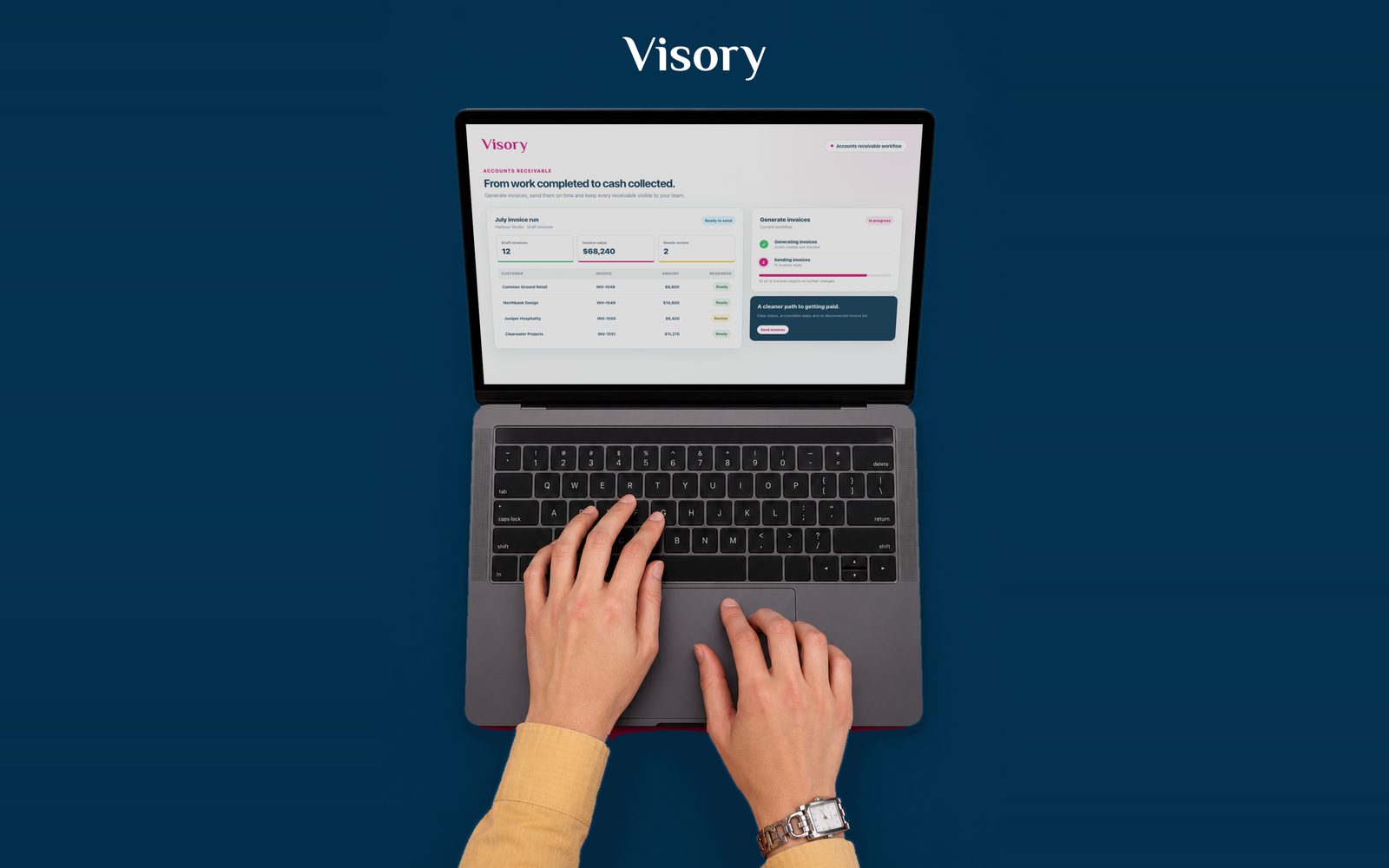
  3. Top-down view of hands on a laptop showing the Visory accounts receivable workflow

    Receive a clear proposal

    A clear commercial proposal for the scope we agree, on one flat monthly fee. No hourly billing. You decide whether to go ahead.

    Flat monthly fee

Get started

The best is ahead for your business.

Start with a discovery call. We will listen first, then show you what your own numbers have been trying to tell you.

Sources (22) · rules last checked October 9, 2026

A different Visory region may suit you

You’re viewing Visory US. Would you like to visit Visory AU?