
Bookkeeping and payroll in Montana

Bookkeeping and payroll for Montana businesses.

Visory provides bookkeeping and payroll services for growing Montana businesses, from professional and design firms to nonprofits. A dedicated team you know by name works inside your own QuickBooks or Xero file, with Delphi AI taking the repetitive parts under that team’s oversight, and keeps your books and pay runs to Montana’s withholding, unemployment insurance, and final pay rules. One flat monthly fee covers the agreed scope.

  • A dedicated team you know by name
  • Montana rules in every pay run and close
  • One flat monthly fee for the agreed scope
The Montana State Capitol in Helena, with its copper dome, above a green lawn in afternoon light.
Photo: Steven Cordes, Unsplash License

Who we work with in Montana

Growing businesses across Montana.

Health care and social assistance is Montana’s largest private industry, with about 76,000 jobs, and professional, scientific, and technical services employ about 29,000 people in about 9,800 establishments (BLS Quarterly Census of Employment and Wages, 2025 annual averages). Across the state, private employers averaged about 427,000 jobs in 2025.

Montana rules

The Montana rules your finance function runs on.

Six rules set by Montana, each with the law that sets it and what it does to your month. Your team works to them every pay run and every close.

A bigger payroll pays faster.

Once withholding in the lookback period reaches $12,000, payments follow the federal deposit schedule rather than the 15th of the month, so each pay run’s tax leaves within days and the books are reconciled every payday.

Set by Montana Code Annotated, Title 15, Chapter 30; House Bill 337 (2025)

From January 1, 2026, Montana’s top income tax rate falls from 5.9% to 5.65%, with a further cut to 5.4% in 2027, and the 4.7% rate applies to taxable income up to $47,500 for single filers ($95,000 joint, $71,250 head of household). Withholding now follows the federal standard deduction. Supplemental wages paid separately may be withheld at a flat 5%. Employers that withheld $12,000 or more in the lookback period pay on the federal schedule; those that withheld $1,200 to $11,999 pay by the 15th of the following month.

Montana Code Annotated, Title 15, Chapter 30; House Bill 337 (2025); rates and withholding tables from January 1, 2026.

The cost runs through most of the year.

With a wage base of $47,300, contributions continue for most staff into the second half of the year, so the cost spreads across quarters instead of landing in January to March.

Set by Montana Unemployment Insurance Law

Employers pay unemployment insurance on the first $47,300 of each employee’s wages in 2026, 80% of the 2024 state average annual wage. Under Schedule 1, rates range from 0.00% to 6.12%. New employers pay their industry’s rate, from 1.00% to 2.00%, with 1.10% for services, plus the 0.18% Administrative Fund Tax. Quarterly wage reports and payment are due April 30, July 31, October 31, and January 31.

Montana Unemployment Insurance Law; 2026 taxable wage base and Rate Schedule 1, for calendar year 2026.

Tips sit on top of the wage.

Every tipped employee is paid at least $10.85 an hour before tips, and $11.20 from January 2027, so tips never reduce the wage cost, and each January’s new rate is loaded into the payroll file before the first pay run of the year.

Set by Montana Code Annotated § 39-3-409

Montana’s minimum wage is $10.85 an hour from January 1, 2026, and rises to $11.20 on January 1, 2027, after a 3.40% rise in the Consumer Price Index, rounded to the nearest $0.05; the state’s notice to employers is dated October 7, 2026. No tip credit, meal credit, or training wage is allowed. A business not covered by the federal Fair Labor Standards Act with gross annual sales of $110,000 or less may pay $4.00, unless an employee is covered by federal law.

Montana Code Annotated § 39-3-409; $10.85 rate effective January 1, 2026; $11.20 from January 1, 2027.

Most service fees carry no sales tax.

A Montana services business has no state sales tax to collect or hold, so receipts are revenue from the day they arrive, unless it also sells meals, lodging, or luxuries in a resort area.

Set by Montana Code Annotated §§ 7-6-1501 and 7-6-1503 (resort tax)

Montana does not have a general sales tax, so a services business charges none on its fees. Communities designated as resort areas may levy a resort tax of up to 3% on lodging, restaurants, bars, destination ski and recreational facilities, and luxuries; ten areas, including Whitefish, Big Sky, Red Lodge, and West Yellowstone, levy 3%. Lodging accommodations also collect a combined 8% lodging facility sales and use tax.

Montana Code Annotated §§ 7-6-1501 and 7-6-1503 (resort tax).

A written policy changes the deadline.

Without one, a layoff or dismissal means final wages are due at once, so a short written final pay policy, kept with the payroll file, gives the Payroll Specialist time to run the final pay correctly.

Set by Montana Code Annotated §§ 39-3-204 and 39-3-205

Employers may not withhold earned wages for longer than 10 business days after they are due and payable. When an employee leaves, unpaid wages are due on the next regular payday for that pay period or 15 days after separation, whichever comes first. When an employee is discharged for cause or laid off, wages are due immediately, unless a written personnel policy extends the time to the next regular payday or 15 days, whichever comes first.

Montana Code Annotated §§ 39-3-204 and 39-3-205; Montana Code Annotated 2025.

Onboarding is part of the first pay run.

The new-hire report and the withholding certificate draw on the same details as the first pay, so both are done the day someone is added to the payroll file.

Set by Montana Code Annotated § 40-5-922; 42 U.S.C. 653a

Montana employers report every employee hired or rehired to New Hire Reporting, run by the Child Support Services Division of the Department of Public Health and Human Services, within 20 days after the date of hire, whether or not the employee has a child support obligation. Each new employee also completes Form MW-4, the Montana withholding and exemption certificate, when they are hired.

Montana Code Annotated § 40-5-922; 42 U.S.C. 653a.

Rules last checked October 9, 2026 against the sources at the foot of this page. General information only. It does not take your circumstances into account.

Local rules

Where the rules change across Montana.

Your team applies the local rules as well as the Montana ones. These are the places where a local tax, a wage rate, or a leave law differs from the rest of the state.

Resort areas

Ten designated resort areas add a local resort tax of 3% on lodging, meals, drinks, recreation, and luxuries sold there.

  • Red Lodge, Virginia City, West Yellowstone, Whitefish, Big Sky, Cooke City, Craig, Gardiner, St. Regis, and Wolf Creek each levy the resort tax at 3%, the maximum rate the law allows.
  • The tax applies to hotels and other lodging, restaurants and other food service, bars, and destination ski or recreational facilities, plus luxuries sold in the resort area. The Department of Revenue does not administer it.
  • Lodging accommodations, in resort areas and across the state, also collect the combined 8% lodging facility sales and use tax: a 4% sales tax and a 4% use tax.


How it works from anywhere

Can a team outside Montana run a Montana business?

Yes. Visory’s US leadership team is in New York, and its teams work with businesses across the United States remotely, inside your own accounting file, so nothing about the work depends on where your office is.

Your own file

Your books stay in your own QuickBooks or Xero file. Your team works inside it, so you see the same numbers they do, whenever you look.

A team you know by name

A dedicated team runs the work, led by a Business Performance Partner. You meet them by video call, and you always know who to ask.

Montana rules, built in

Visory runs the finance function for growing businesses across the United States, with its US leadership team in New York. Your books stay in your own QuickBooks or Xero file, and your team works inside it with you. Every pay run and every close is checked against the rules on this page.

Business hours, and the platform after them

Your team works 9am to 5pm Eastern Time on business days, all year round, and the Visory platform is open to you around the clock for documents, approvals, and your numbers.

Visory Insights

What your numbers should show in Montana.

Clean books are the start. Every month, Insights turns them into a plain-English report, and a named Business Performance Partner walks your leadership team through what they mean for the year ahead.

Unemployment cost spreads across the year

At the 1.10% services rate plus the 0.18% Administrative Fund Tax, each new employee costs up to $605.44 in 2026, 1.28% of $47,300. Someone paid $60,000 a year passes the base in October, so contributions run into the fourth quarter. Insights spreads the cost to match.

Budget for the January rise

Montana resets its minimum wage for inflation each year, and the notice dated October 7, 2026, lifts it from $10.85 to $11.20 on January 1, 2027. That $0.35 step adds $728 a year for a full-time employee on 2,080 hours. Insights builds next year’s payroll budget from the new rate.

Withholding speeds up at $12,000

The lookback period runs from July 1 to June 30, and withholding of $12,000 or more in it, about $1,000 a month, moves payments onto the federal schedule. Insights flags the year your payroll crosses that line, so the cash for each deposit is ready.

Looking for a fractional CFO in Montana? Visory has no standalone CFO offer. That work sits inside Visory Insights and your sessions with a Business Performance Partner. See Visory Insights

What customers say

In a customer’s words.

“Visory applies a commercial lens to how we manage client revenue, always ensuring we balance serving our clients with our business' best interests.”

Rachelle Harper Co-founder and COO, BrandBossHQ

Common questions

Questions Montana businesses ask.

Straight answers about bookkeeping and payroll for a Montana business, from a team that works remotely.

Does Visory have an office in Montana?

Visory’s US leadership team is in New York, and its teams work with growing businesses across the United States remotely, so we support businesses in Montana as we do everywhere else. A Montana business gets a dedicated team you know by name, who keep the books and run payroll inside your own QuickBooks or Xero file and meet you by video call. Your records stay in your file, which you can open at any time.

What hours does my Visory team work?

Your team works 9am to 5pm Eastern Time on business days, all year round. Outside those hours, the Visory platform is your 24/7 access point, so your financial information is there whenever you need it.

Can a bookkeeper outside my office look after a Montana business?

Yes. What matters is that the team knows Montana’s rules and works inside your own accounting file. Visory connects to your bank feeds and software, codes and reconciles transactions through the month with Delphi AI working under an expert team, and meets you by video call. Nothing about the work depends on where your office is.

How much does a bookkeeper cost in Montana?

Visory charges one flat monthly fee for the scope we agree, with no hourly billing and no timesheets. The fee reflects the services you take, from bookkeeping and payroll to accounts payable, accounts receivable, and Insights, and the volume of work in your business. After a discovery call, you get a clear proposal, so you know the monthly cost before you start.

See how pricing works

Do you work in QuickBooks and Xero?

Yes. Visory works inside the systems you already use: QuickBooks and Xero for the ledger, Gusto and Rippling for pay runs, and Bill, Ramp, and Stripe for payments, along with your bank feeds. Your books stay in your own accounting file, which you own and can open at any time. Any change to your setup is agreed with you first.

Do Montana businesses charge sales tax?

Montana does not have a general sales tax, so most services businesses charge none. Designated resort areas such as Whitefish and Big Sky levy a 3% resort tax on lodging, meals, drinks, recreation, and luxuries, and lodging carries an 8% lodging facility sales and use tax. This is general information; the Department of Revenue sets the rules for your business.

How much Montana income tax is withheld in 2026?

From January 1, 2026, the top rate is 5.65%, down from 5.9%, and the 4.7% rate covers taxable income up to $47,500 for single filers. Withholding now follows the federal standard deduction, so employees who have not updated Form MW-4 since 2023 may need to. Your Payroll Specialist applies the 2026 tables to every pay run. This is general information; the Department of Revenue sets the rules.

When is final pay due in Montana?

When an employee quits, final wages are due by the next regular payday or within 15 days, whichever comes first. When an employee is discharged for cause or laid off, they are due immediately, unless a written personnel policy extends the time to the same limit. Your Payroll Specialist runs the final pay to that deadline. This is general information; the Department of Labor and Industry sets the rules.

Can you look after staff in more than one state?

Yes. Each state sets its own income tax withholding, unemployment insurance, minimum wage, and leave rules, and Montana does not require withholding from nonresidents who work in the state for less than 30 days and in more than one state, with some exceptions. Visory keeps one set of books and runs payroll with each state’s rules applied to the staff who work there.

Do you offer a fractional CFO in Montana?

A fractional CFO advises on numbers someone else produces. Visory runs the books, payroll, and payments, then delivers the insight from the same team: Visory Insights is a plain-English monthly report and a session with a named Business Performance Partner. There is no handover between the doing and the advising, and it comes on one flat monthly fee.

See how Visory Insights works
More questions, longer answers. Every question has its own link. See all common questions

Getting started

Start with clarity, not a contract.

Three steps, in whatever rhythm suits you. Each one is useful on its own.

  1. Two people shake hands across a desk beside a laptop

    Book a discovery call

    An obligation-free conversation about your goals and what you want the numbers to tell you.

    Obligation-free
  2. A woman takes notes beside a laptop showing a financial report

    Get your free financial health check

    A senior member of the Visory team analyzes your financials and shows you where your finance function can improve. It is free, and it is your own numbers.

    Free · your own numbers
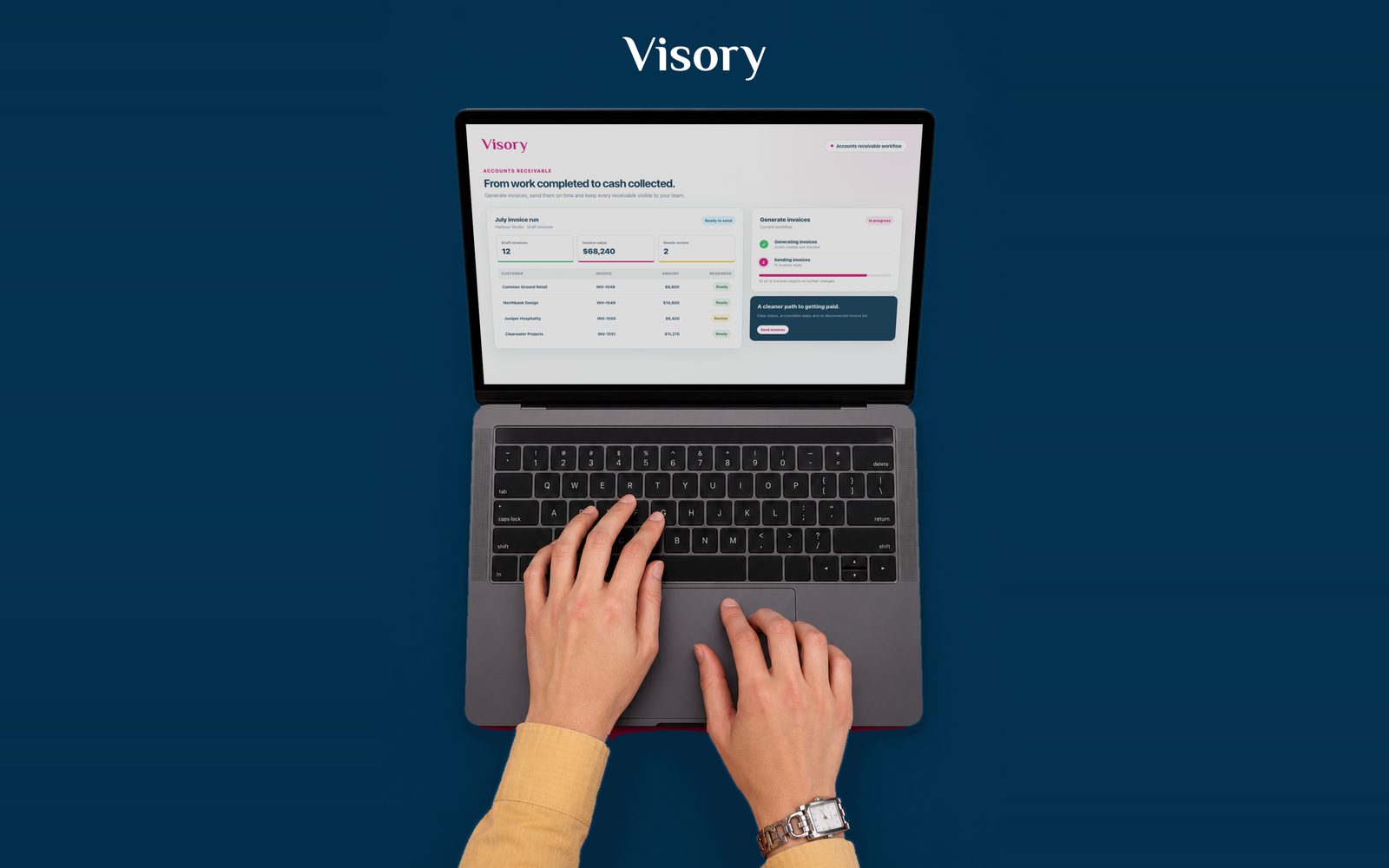
  3. Top-down view of hands on a laptop showing the Visory accounts receivable workflow

    Receive a clear proposal

    A clear commercial proposal for the scope we agree, on one flat monthly fee. No hourly billing. You decide whether to go ahead.

    Flat monthly fee

Get started

The best is ahead for your business.

Start with a discovery call. We will listen first, then show you what your own numbers have been trying to tell you.

Sources (14) · rules last checked October 9, 2026

A different Visory region may suit you

You’re viewing Visory US. Would you like to visit Visory AU?