

Bookkeeping and payroll in Colorado

Bookkeeping and payroll for Colorado businesses.

Visory provides bookkeeping and payroll services for growing Colorado businesses, from professional firms and consultancies to nonprofits. A dedicated team you know by name works inside your own QuickBooks or Xero file, with Delphi AI taking the repetitive parts under that team’s oversight, and keeps your books and pay runs to Colorado’s withholding, family leave, and sales tax rules. One flat monthly fee covers the agreed scope.

  • A dedicated team you know by name
  • Colorado rules in every pay run and close
  • One flat monthly fee for the agreed scope
Downtown Denver from the air, with the Rocky Mountains on the horizon.
Photo: Acton Crawford, Unsplash License

Who we work with in Colorado

Growing businesses across Colorado.

Health care and social assistance is Colorado’s largest private industry, with about 350,000 jobs, and professional, scientific, and technical services employ about 291,000 people, nearly one and a half times their share of jobs nationally (BLS Quarterly Census of Employment and Wages, 2025 annual averages). Across the state, private employers averaged 2.43 million jobs in 2025.

Colorado rules

The Colorado rules your finance function runs on.

Eight rules set by Colorado, each with the law that sets it and what it does to your month. Your team works to them every pay run and every close.

The filing calendar follows the total.

Once a year’s withholding reaches $7,000, returns move from quarterly to monthly, and at $50,000 to weekly, so a growing team changes how often tax leaves the account, and the cash plan moves with it.

Set by Colorado Revised Statutes, § 39-22-604; Form DR 1098 (2026)

Employers work out Colorado withholding at a flat 4.40% with the 2026 DR 1098 worksheet, from each employee’s W-4 or Colorado DR 0004. Colorado wages are those paid to Colorado residents, and to nonresidents for work performed in Colorado. Employers with less than $7,000 of annual withholding file quarterly, those with $7,000 to $50,000 file monthly by the 15th, and those with $50,000 or more file weekly.

Colorado Revised Statutes, § 39-22-604; Form DR 1098 (2026); 2026 Colorado Withholding Worksheet for Employers (DR 1098).

A higher base stretches the cost.

With premiums due on wages up to $30,600, the cost runs past the first quarter for most employees, and the base went up again for 2026, so each year’s budget starts from that year’s base rather than last year’s.

Set by Colorado Employment Security Act

Employers pay unemployment insurance premiums on the first $30,600 of each employee’s wages in 2026, up from $27,200 in 2025. New non-construction employers pay an introductory 3.05%: a 1.53% base rate, a 0.17% support rate, and a 1.35% solvency surcharge. Experienced employers’ standard rates run from 0.56% to 7.34% before surcharges. Wage reports and premiums are due April 30, July 31, October 31, and January 31.

Colorado Employment Security Act; 2026 chargeable wage limit and rate tables.

The rate follows the work location.

Staff in Denver are paid at least $19.29 while staff elsewhere in the state may be on $15.16, so each employee’s work location in the payroll file decides which floor applies.

Set by Colorado Constitution (minimum wage indexed to inflation)

The state minimum wage is $15.16 an hour in 2026, and $12.14 for tipped employees. It rises to $15.71, and $12.69 for tipped workers, in 2027, adjusted for inflation each year as the state’s constitution requires. Cities and counties may set higher rates by local ordinance: Denver’s minimum wage is $19.29 an hour in 2026 and $19.84 in 2027.

Colorado Constitution (minimum wage indexed to inflation); 2026 rates; increase announced for 2027.

Two tax authorities, two returns.

A sale in a home-rule city such as Denver can owe that city’s own sales tax on a separate return, so the books track tax collected by jurisdiction, not as one combined figure.

Set by Colorado Revised Statutes, § 39-26-104; Colorado Sales Tax Guide

Colorado sales tax applies to retail sales of tangible personal property and, in general, not to services unless the law specifically taxes them, though a bundled sale of property and services may be taxable in full. The state rate is 2.9%, plus state-administered local taxes, and home-rule cities may collect their own: Denver’s combined general rate is 9.15%. Returns are monthly, quarterly where average monthly tax is over $50 but under $1,100, or annual at $50 or less, due the 20th.

Colorado Revised Statutes, § 39-26-104; Colorado Sales Tax Guide; Colorado Sales Tax Guide, revised May 2026.

Accrual starts on day one.

Leave builds from the first hour worked, part-time staff included, so the payroll file tracks every employee’s balance from their first pay run, with carried-over hours kept apart from the year’s use.

Set by Colorado Healthy Families and Workplaces Act

All employers provide paid sick leave to all employees, including part-time and temporary staff. Employees earn one hour for every 30 hours worked, up to 48 hours a year, from their first day of work, and overtime-exempt employees accrue as if they work 40 hours a week. Up to 48 hours of unused leave carries over to the next year, but an employer need not allow more than 48 hours of use in one benefit year.

Colorado Healthy Families and Workplaces Act; all employers, regardless of size, from 2022.

The reason for leaving sets the deadline.

Final wages are due the moment the employer ends the job, while a resignation can wait for the next payday, so a dismissal means a final pay run prepared the same day.

Set by Colorado Wage Act, C.R.S. §§ 8-4-103 and 8-4-109

Employers set regular pay periods of no longer than one calendar month or 30 days, whichever is longer, with paydays no later than 10 days after each period closes, and post a notice of the regular paydays. When an employer fires or lays off an employee, all wages owed are due immediately. When an employee quits or resigns, all wages owed are due by the next regular payday.

Colorado Wage Act, C.R.S. §§ 8-4-103 and 8-4-109.

Onboarding is part of the pay run.

The new-hire report draws on the same details as the first pay, so it is done the day someone is added to the payroll file, and a returning employee is checked against the 60-day rule.

Set by 42 U.S.C. 653a; Colorado State Directory of New Hires

Employers report every newly hired employee to the Colorado State Directory of New Hires within 20 calendar days of the hire, or with the first scheduled payroll if that falls after the 20 days. A returning employee counts as a new hire after 60 consecutive days away. The report gives the employee’s name, address, Social Security number, date of birth, and first day of work, with the employer’s payroll address and FEIN.

42 U.S.C. 653a; Colorado State Directory of New Hires.

Two shares, one cap.

The employer’s 0.44% is a cost of employment and the employee’s 0.44% is a deduction, both stopping at $184,500 of wages, so the payroll file splits them and the quarterly report agrees with both.

Set by Colorado FAMLI program (voter-approved), as amended by S.B. 25-144

Employers and employees fund Colorado’s Paid Family and Medical Leave Insurance program. Premiums are 0.88% of wages in 2026, 0.44% paid by the employer and 0.44% by the employee, on wages up to the Social Security wage cap, $184,500 in 2026. Businesses with nine or fewer employees send in only the employee’s 0.44%. The rate falls to 0.86% in 2027. Wage reports and premiums are filed each quarter.

Colorado FAMLI program (voter-approved), as amended by S.B. 25-144; 0.88% from the start of 2026; 0.86% from 2027.

Rules last checked October 9, 2026 against the sources at the foot of this page. General information only. It does not take your circumstances into account.

Local rules

Where the rules change across Colorado.

Your team applies the local rules as well as the Colorado ones. These are the places where a local tax, a wage rate, or a leave law differs from the rest of the state.

The gold dome of the Colorado State Capitol in front of downtown Denver’s towers.
Photo: Acton Crawford, Unsplash License

Denver

Denver sets a higher minimum wage, charges a monthly head tax on employees and employers, and collects its own sales tax.

  • Denver’s minimum wage is $19.29 an hour in 2026 and rises to $19.84 in 2027, recalculated each year from the Consumer Price Index by the Denver Department of Finance.
  • The occupational privilege tax applies to anyone paid at least $500 in a month for work in Denver: employers withhold $5.75 a month from the employee and pay $4.00 a month for each one, and for each owner, partner, or manager.
  • As a home-rule city, Denver collects its own sales tax, 5.15% for a combined general rate of 9.15%, and lists informational services and software as a service among its taxable services. Returns go through Denver’s eBiz tax center or the state’s SUTS portal.


How it works from anywhere

Can a team outside Colorado run a Colorado business?

Yes. Visory’s US leadership team is in New York, and its teams work with businesses across the United States remotely, inside your own accounting file, so nothing about the work depends on where your office is.

Your own file

Your books stay in your own QuickBooks or Xero file. Your team works inside it, so you see the same numbers they do, whenever you look.

A team you know by name

A dedicated team runs the work, led by a Business Performance Partner. You meet them by video call, and you always know who to ask.

Colorado rules, built in

Visory runs the finance function for growing businesses across the United States, with its US leadership team in New York. Your books stay in your own QuickBooks or Xero file, and your team works inside it with you. Every pay run and every close is checked against the rules on this page.

Business hours, and the platform after them

Your team works 9am to 5pm Eastern Time on business days, all year round, and the Visory platform is open to you around the clock for documents, approvals, and your numbers.

Visory Insights

What your numbers should show in Colorado.

Clean books are the start. Every month, Insights turns them into a plain-English report, and a named Business Performance Partner walks your leadership team through what they mean for the year ahead.

Unemployment premiums on $30,600 a head

At the 3.05% introductory rate, a new employer pays up to $933.30 a year for each employee on the first $30,600 of wages, and for anyone paid more than $122,400 a year, all of it falls in the first quarter. Insights puts that into the cash flow forecast.

Family leave premiums fall in 2027

The FAMLI premium falls from 0.88% to 0.86% of wages in 2027, so for an employee paid $100,000 the total drops from $880 to $860, and on $5 million of wages below the cap by $1,000 a year. Insights carries the new rate into next year’s budget.

Minimum wages rise 55 cents in 2027

The state rate rises from $15.16 to $15.71 and Denver’s from $19.29 to $19.84, both up $0.55 an hour. For a full-time employee at 2,080 hours, that is about $1,144 more a year. Insights prices each affected role into the 2027 budget.

Looking for a fractional CFO in Colorado? Visory has no standalone CFO offer. That work sits inside Visory Insights and your sessions with a Business Performance Partner. See Visory Insights

What customers say

In a customer’s words.

“Visory applies a commercial lens to how we manage client revenue, always ensuring we balance serving our clients with our business' best interests.”

Rachelle Harper Co-founder and COO, BrandBossHQ

Common questions

Questions Colorado businesses ask.

Straight answers about bookkeeping and payroll for a Colorado business, from a team that works remotely.

Does Visory have an office in Colorado?

Visory’s US leadership team is in New York, and its teams work with growing businesses across the United States remotely, so we support businesses in Colorado as we do everywhere else. A Colorado business gets a dedicated team you know by name, who keep the books and run payroll inside your own QuickBooks or Xero file and meet you by video call. Your records stay in your file, which you can open at any time.

What hours does my Visory team work?

Your team works 9am to 5pm Eastern Time on business days, all year round. Outside those hours, the Visory platform is your 24/7 access point, so your financial information is there whenever you need it.

Can a bookkeeper outside my office look after a Colorado business?

Yes. What matters is that the team knows Colorado’s rules and works inside your own accounting file. Visory connects to your bank feeds and software, codes and reconciles transactions through the month with Delphi AI working under an expert team, and meets you by video call. Nothing about the work depends on where your office is.

How much does a bookkeeper cost in Colorado?

Visory charges one flat monthly fee for the scope we agree, with no hourly billing and no timesheets. The fee reflects the services you take, from bookkeeping and payroll to accounts payable, accounts receivable, and Insights, and the volume of work in your business. After a discovery call, you get a clear proposal, so you know the monthly cost before you start.

See how pricing works

Do you work in QuickBooks and Xero?

Yes. Visory works inside the systems you already use: QuickBooks and Xero for the ledger, Gusto and Rippling for pay runs, and Bill, Ramp, and Stripe for payments, along with your bank feeds. Your books stay in your own accounting file, which you own and can open at any time. Any change to your setup is agreed with you first.

Do Colorado businesses charge sales tax on services?

In general, no. Colorado taxes retail sales of tangible personal property and only the services the law specifically taxes, though a bundled sale of property and services may be taxable in full. The state rate is 2.9%, plus local taxes, and home-rule cities such as Denver collect their own. This is general information; the Colorado Department of Revenue sets the rules.

What is Denver’s occupational privilege tax?

It is a monthly head tax on work in Denver. For each employee paid at least $500 in a month for work in the city, you withhold $5.75 from their pay and pay $4.00 yourself, and you also pay $4.00 for each owner, partner, or manager. The employee need not live in Denver. This is general information; the Denver Department of Finance sets the rules.

How much is the Colorado FAMLI premium?

In 2026 it is 0.88% of wages, 0.44% from the employer and 0.44% from the employee, on wages up to $184,500. Businesses with nine or fewer employees send in only the employee’s share. The rate falls to 0.86% in 2027. Your Payroll Specialist splits the two shares in every pay run and prepares the quarterly wage report from the same runs.

Can you look after staff in more than one state?

Yes. Each state sets its own income tax withholding, unemployment insurance, minimum wage, and leave rules, and Colorado wage withholding applies to residents wherever they work and to nonresidents for the work they do in Colorado. Visory keeps one set of books and runs payroll with each state’s rules applied, so every state’s cost shows in one monthly report.

Do you offer a fractional CFO in Colorado?

A fractional CFO advises on numbers someone else produces. Visory runs the books, payroll, and payments, then delivers the insight from the same team: Visory Insights is a plain-English monthly report and a session with a named Business Performance Partner. There is no handover between the doing and the advising, and it comes on one flat monthly fee.

See how Visory Insights works
More questions, longer answers. Every question has its own link. See all common questions

Getting started

Start with clarity, not a contract.

Three steps, in whatever rhythm suits you. Each one is useful on its own.

  1. Two people shake hands across a desk beside a laptop

    Book a discovery call

    An obligation-free conversation about your goals and what you want the numbers to tell you.

    Obligation-free
  2. A woman takes notes beside a laptop showing a financial report

    Get your free financial health check

    A senior member of the Visory team analyzes your financials and shows you where your finance function can improve. It is free, and it is your own numbers.

    Free · your own numbers
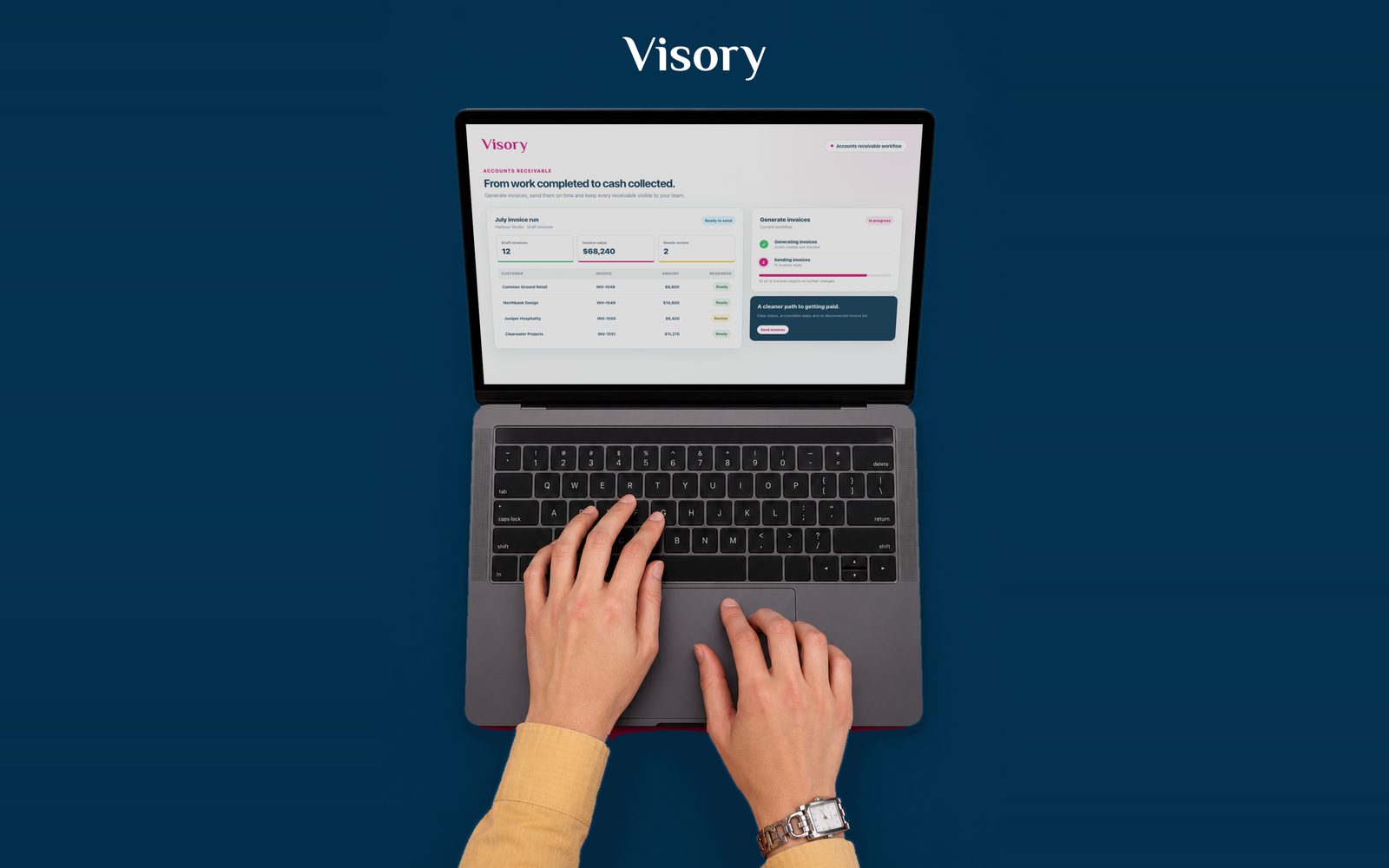
  3. Top-down view of hands on a laptop showing the Visory accounts receivable workflow

    Receive a clear proposal

    A clear commercial proposal for the scope we agree, on one flat monthly fee. No hourly billing. You decide whether to go ahead.

    Flat monthly fee

Get started

The best is ahead for your business.

Start with a discovery call. We will listen first, then show you what your own numbers have been trying to tell you.

Sources (17) · rules last checked October 9, 2026

A different Visory region may suit you

You’re viewing Visory US. Would you like to visit Visory AU?