

Bookkeeping and payroll in Oregon

Bookkeeping and payroll for Oregon businesses.

Visory provides bookkeeping and payroll services for growing Oregon businesses, from professional firms and consultancies to nonprofits. A dedicated team you know by name works inside your own QuickBooks or Xero file, with Delphi AI taking the repetitive parts under that team’s oversight, and keeps your books and pay runs to Oregon’s withholding, transit tax, Paid Leave Oregon, and corporate activity tax rules. One flat monthly fee covers the agreed scope.

  • A dedicated team you know by name
  • Oregon rules in every pay run and close
  • One flat monthly fee for the agreed scope
Downtown Portland and Mount Hood at first light, seen from the West Hills.
Photo: Adam Blank, Unsplash License

Who we work with in Oregon

Growing businesses across Oregon.

Health care and social assistance is Oregon’s largest private industry, with about 315,000 jobs, and computer and electronic product manufacturing employs about 35,000 people, 2.7 times its share of jobs nationally (BLS Quarterly Census of Employment and Wages, 2025 annual averages). Across the state, private employers averaged about 1.69 million jobs in 2025.

Oregon rules

The Oregon rules your finance function runs on.

Eight rules set by Oregon, each with the law that sets it and what it does to your month. Your team works to them every pay run and every close.

Two state deductions on every pay stub.

Income tax and the transit tax are withheld together and paid on the federal deposit schedule, so a business that deposits semiweekly for the IRS pays Oregon on the same days, and each payment has to agree with its payroll.

Set by Oregon personal income tax withholding, ORS 316.162; Publication 150-206-436

Employers withhold Oregon income tax using the 2026 formulas in Publication 150-206-436, at rates from 4.75% to 9.9%. Supplemental wages paid apart from regular pay may be withheld at a flat 8%, the rate also used when an employee gives no withholding statement. Payments fall due on the same dates as federal deposits. Employers also withhold the statewide transit tax, one-tenth of 1%, from residents’ wages and from nonresidents’ wages for work in Oregon, and report both on the quarterly Form OQ.

Oregon personal income tax withholding, ORS 316.162; Publication 150-206-436; withholding formulas effective January 1, 2026.

The cost stops partway through the year.

Tax is due only until an employee’s wages pass $56,700, so for staff on higher salaries the cost falls in the first two quarters, and a budget that spreads it evenly overstates the second half.

Set by Oregon Employment Department Law, ORS chapter 657 (Tax Schedule 3)

Employers pay unemployment insurance tax on the first $56,700 of each employee’s wages in 2026, up from $54,300 in 2025. Under Tax Schedule 3, rates run from 0.9% to 5.4%, and new employers pay 2.4%. Unemployment tax is reported with withholding, transit tax, and Paid Leave contributions on Form OQ, due April 30, July 31, October 31, and January 31.

Oregon Employment Department Law, ORS chapter 657 (Tax Schedule 3); 2026 taxable wage base and tax rates.

The pay floor moves in July, not January.

Pay rates near the minimum need a review before the first pay run after July 1 each year, and each employee’s work location in the payroll file decides which of the three rates applies.

Set by Oregon minimum wage law, rates published by the Bureau of Labor and Industries

Oregon’s minimum wage depends on where the work is done. From July 1, 2026, through June 30, 2027, it is $16.80 an hour inside the Portland metro urban growth boundary, $15.55 in standard counties such as Lane, Marion, and Deschutes, and $14.55 in nonurban counties. The rates rise with inflation each July 1. Tip credits are illegal in Oregon, so tips cannot count toward the minimum wage.

Oregon minimum wage law, rates published by the Bureau of Labor and Industries; rates from July 1, 2026, through June 30, 2027.

The tax follows revenue, not profit.

No sales tax is added to invoices, but once Oregon commercial activity passes $1 million the tax is owed even in a loss year, so the books track Oregon revenue through the year to time registration and estimates.

Set by Oregon Corporate Activity Tax, ORS chapter 317A

Oregon has no general sales or use tax. Instead, businesses with more than $750,000 of Oregon commercial activity register for the corporate activity tax, and those above $1 million file and pay $250 plus 0.57% of taxable commercial activity over $1 million, after a 35% subtraction for certain costs. A business expecting $5,000 or more of tax makes quarterly estimated payments, due by the last day of the fourth, seventh, and tenth months of its tax year and the month after it ends.

Oregon Corporate Activity Tax, ORS chapter 317A; tax years beginning on or after January 1, 2020.

Headcount decides whether it is paid.

A business crossing 10 Oregon employees, or 6 with a Portland location, starts paying for sick time it previously only had to protect, so the payroll file tracks accrued hours for everyone from day one.

Set by ORS 653.601 to 653.661; OAR 839-007

Employees earn at least 1 hour of protected sick time for every 30 hours worked, up to 40 hours a year, or the employer may front-load at least 40 hours at the start of the year. Sick time is paid when the employer has 10 or more Oregon employees, or 6 or more with a location in Portland, and employees may begin taking it after 90 days of employment.

ORS 653.601 to 653.661; OAR 839-007.

A dismissal moves the payday.

Final pay for someone let go is due the next business day, not on the next pay run, so payroll has to be ready to pay outside the normal cycle, and late final wages carry a penalty for each day they go unpaid.

Set by ORS 652.110, 652.120, 652.140, and 652.150

Employers pay on a regular payday schedule, with paydays no more than 35 days apart. An employee who is fired or let go is paid by the end of the next business day. One who quits with at least 48 hours’ notice is paid on their last day, and one who quits with less notice is paid within five business days or on the next regular payday, whichever comes first.

ORS 652.110, 652.120, 652.140, and 652.150.

Onboarding is part of the pay run.

The new-hire report draws on the same setup as the first pay, so it is done the day someone is added to the payroll file, and contractors expected past 20 days are reported when they are engaged.

Set by Oregon new hire reporting to the Oregon Child Support Program

Employers report every new hire and rehire to the Oregon Child Support Program within 20 days of the hire date, including each new hire’s first day of work. Since January 1, 2024, employers also report independent contractors who submit a Form W-9 and are expected to work more than 20 days in a calendar year, within the same timeframe.

Oregon new hire reporting to the Oregon Child Support Program; independent contractor reporting from January 1, 2024.

A deduction with a ceiling, and a cost at 25 staff.

The withholding stops once wages reach $184,500 for the year, and a business that averages 25 or more employees starts paying 0.4% of payroll itself, so headcount is checked before each year’s budget.

Set by Paid Leave Oregon, ORS chapter 657B

Paid Leave Oregon contributions are 1% of gross wages in 2026, on wages up to $184,500 per employee, the 2026 Social Security taxable maximum. Every employer withholds the employee share, 60% of the contribution. Large employers, with 25 or more employees on average, also pay the employer share, 40% of the contribution; small employers with fewer than 25 do not. Contributions are reported each quarter on Form OQ.

Paid Leave Oregon, ORS chapter 657B; 2026 contribution rate and wage base.

Rules last checked October 9, 2026 against the sources at the foot of this page. General information only. It does not take your circumstances into account.

Local rules

Where the rules change across Oregon.

Your team applies the local rules as well as the Oregon ones. These are the places where a local tax, a wage rate, or a leave law differs from the rest of the state.

A green Gothic tower of the St. Johns Bridge in Portland, seen from below against a cloudy sky.
Photo: Tyler Collins, Unsplash License

Portland metro

Inside the TriMet district and the urban growth boundary, employers pay a transit payroll tax and a higher minimum wage, and a Portland location makes sick time paid sooner.

  • Employers pay the TriMet transit tax themselves, at 0.8237% in 2026, on gross payroll for work their employees do inside the district, which covers parts of Multnomah, Washington, and Clackamas counties.
  • The minimum wage inside the Portland metro urban growth boundary is $16.80 an hour from July 1, 2026, against $15.55 in standard counties.
  • Sick time is paid once an employer has 6 or more Oregon employees if it has a location in Portland, rather than the 10 or more that applies elsewhere.


Metro and Multnomah County

Two local income taxes apply to higher earners who live or work in the Metro area or in Multnomah County, with employer withholding.

  • The Metro Supportive Housing Services tax is 1% of taxable income above $128,000 single or $205,000 joint for 2026. Employers with a Metro location withhold 1% above $200,000 from employees working in Metro who earn $200,000 or more.
  • The Multnomah County Preschool for All tax is 1.5% above $125,000 single or $200,000 joint, plus 1.5% more above $250,000 or $400,000. Employers there withhold 1.5% above $200,000 and 3% above $400,000.
  • Employers file quarterly withholding returns and an annual reconciliation for both taxes with the City of Portland’s Revenue Division, and no extension is available for either.
Downtown Eugene among tall evergreens, with Spencer Butte rising beyond under summer clouds.
Photo: Don Hankins, CC BY 2.0, cropped

Eugene and Springfield

The Lane Transit District adds an employer-paid payroll tax for work done in the Eugene and Springfield area.

  • Employers pay the Lane Transit District tax themselves, at 0.80% in 2026, on gross payroll for work their employees do in the district, which serves the Eugene and Springfield urban area and several rural areas.
  • Lane County is a standard county for the minimum wage, so the rate there is $15.55 an hour from July 1, 2026.

How it works from anywhere

Can a team outside Oregon run an Oregon business?

Yes. Visory’s US leadership team is in New York, and its teams work with businesses across the United States remotely, inside your own accounting file, so nothing about the work depends on where your office is.

Your own file

Your books stay in your own QuickBooks or Xero file. Your team works inside it, so you see the same numbers they do, whenever you look.

A team you know by name

A dedicated team runs the work, led by a Business Performance Partner. You meet them by video call, and you always know who to ask.

Oregon rules, built in

Visory runs the finance function for growing businesses across the United States, with its US leadership team in New York. Your books stay in your own QuickBooks or Xero file, and your team works inside it with you. Every pay run and every close is checked against the rules on this page.

Business hours, and the platform after them

Your team works 9am to 5pm Eastern Time on business days, all year round, and the Visory platform is open to you around the clock for documents, approvals, and your numbers.

Visory Insights

What your numbers should show in Oregon.

Clean books are the start. Every month, Insights turns them into a plain-English report, and a named Business Performance Partner walks your leadership team through what they mean for the year ahead.

Unemployment tax, front-loaded

At the 2.4% new-employer rate on the $56,700 wage base, each employee costs up to $1,360.80 in unemployment tax in 2026, and for anyone paid more than $113,400 a year, all of it falls in the first half. Insights puts that into the cash flow forecast.

When the corporate activity tax needs estimates

At $250 plus 0.57% above $1 million, tax reaches the $5,000 estimated payment threshold at about $1.83 million of taxable Oregon commercial activity. On $1.5 million it is $3,100. Insights tracks Oregon revenue each month, so you know which side of the line the year will land.

Paid Leave Oregon costs more at 25 employees

Once a business averages 25 employees, it pays 40% of the 1% contribution itself: $8,000 a year on $2 million of payroll below the $184,500 cap, on top of the 0.6% it withholds from employees. Insights shows that cost in the budget before the hire that crosses the line.

Looking for a fractional CFO in Oregon? Visory has no standalone CFO offer. That work sits inside Visory Insights and your sessions with a Business Performance Partner. See Visory Insights

What customers say

In a customer’s words.

“Visory ensures we have a clear view of who we need to pay and how that impacts cash flow so that there are no surprises.”

Rachelle Harper Co-founder and COO, BrandBossHQ

Common questions

Questions Oregon businesses ask.

Straight answers about bookkeeping and payroll for an Oregon business, from a team that works remotely.

Does Visory have an office in Oregon?

Visory’s US leadership team is in New York, and its teams work with growing businesses across the United States remotely, so we support businesses in Oregon as we do everywhere else. An Oregon business gets a dedicated team you know by name, who keep the books and run payroll inside your own QuickBooks or Xero file and meet you by video call. Your records stay in your file, which you can open at any time.

What hours does my Visory team work?

Your team works 9am to 5pm Eastern Time on business days, all year round. Outside those hours, the Visory platform is your 24/7 access point, so your financial information is there whenever you need it.

Can a bookkeeper outside my office look after an Oregon business?

Yes. What matters is that the team knows Oregon’s rules and works inside your own accounting file. Visory connects to your bank feeds and software, codes and reconciles transactions through the month with Delphi AI working under an expert team, and meets you by video call. Nothing about the work depends on where your office is.

How much does a bookkeeper cost in Oregon?

Visory charges one flat monthly fee for the scope we agree, with no hourly billing and no timesheets. The fee reflects the services you take, from bookkeeping and payroll to accounts payable, accounts receivable, and Insights, and the volume of work in your business. After a discovery call, you get a clear proposal, so you know the monthly cost before you start.

See how pricing works

Do you work in QuickBooks and Xero?

Yes. Visory works inside the systems you already use: QuickBooks and Xero for the ledger, Gusto and Rippling for pay runs, and Bill, Ramp, and Stripe for payments, along with your bank feeds. Your books stay in your own accounting file, which you own and can open at any time. Any change to your setup is agreed with you first.

Do Oregon businesses charge sales tax?

No. Oregon has no general sales or use tax, so nothing is added to your invoices. Instead, a business with more than $1 million of taxable Oregon commercial activity pays the corporate activity tax, $250 plus 0.57% of the amount above $1 million, and registers once activity passes $750,000. This is general information; the Department of Revenue sets the rules.

Do Oregon employers have to pay for sick time?

Every employer must let employees earn sick time, at least 1 hour for every 30 hours worked, up to 40 hours a year. It must be paid when the employer has 10 or more Oregon employees, or 6 or more with a location in Portland, and employees can use it after 90 days. This is general information; the Bureau of Labor and Industries sets the rules.

Can you look after staff in more than one state?

Yes. Each state sets its own income tax withholding, unemployment insurance, minimum wage, and leave rules, and Oregon withholds income tax from nonresidents for work they do in the state unless their Oregon earnings will be below the standard deduction. Visory keeps one set of books and runs payroll with each state’s rules applied to the staff who work there.

Do you offer a fractional CFO in Oregon?

A fractional CFO advises on numbers someone else produces. Visory runs the books, payroll, and payments, then delivers the insight from the same team: Visory Insights is a plain-English monthly report and a session with a named Business Performance Partner. There is no handover between the doing and the advising, and it comes on one flat monthly fee.

See how Visory Insights works
More questions, longer answers. Every question has its own link. See all common questions

Getting started

Start with clarity, not a contract.

Three steps, in whatever rhythm suits you. Each one is useful on its own.

  1. Two people shake hands across a desk beside a laptop

    Book a discovery call

    An obligation-free conversation about your goals and what you want the numbers to tell you.

    Obligation-free
  2. A woman takes notes beside a laptop showing a financial report

    Get your free financial health check

    A senior member of the Visory team analyzes your financials and shows you where your finance function can improve. It is free, and it is your own numbers.

    Free · your own numbers
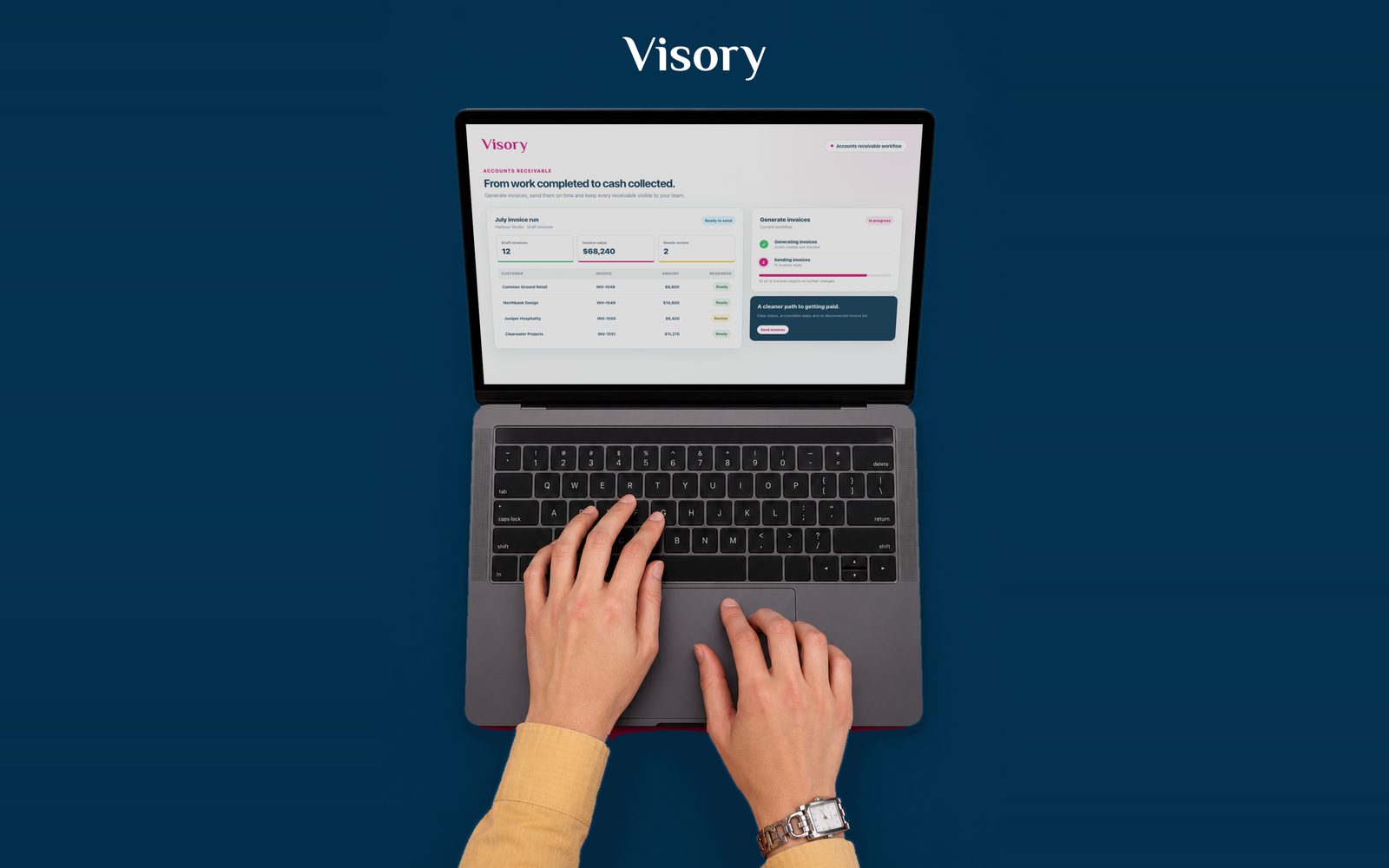
  3. Top-down view of hands on a laptop showing the Visory accounts receivable workflow

    Receive a clear proposal

    A clear commercial proposal for the scope we agree, on one flat monthly fee. No hourly billing. You decide whether to go ahead.

    Flat monthly fee

Get started

The best is ahead for your business.

Start with a discovery call. We will listen first, then show you what your own numbers have been trying to tell you.

Sources (14) · rules last checked October 9, 2026

A different Visory region may suit you

You’re viewing Visory US. Would you like to visit Visory AU?