
116 days ▲ +18 days since April
For law firms
Billing, payroll, and practice numbers, kept current.
We run your finance function. You get strategic insights. For US law firms, a dedicated team runs bookkeeping, payroll, accounts payable, and accounts receivable with Delphi AI under their oversight. Once a month, Visory Insights shows the partners how billing, work in progress, and cash are tracking.
- Aged receivables reported every week, by partner and by matter, and unbilled time every month, while the fees can still be collected.
- A named Payroll Specialist runs every pay run, checked by Delphi AI before you approve it, with attorneys and staff paid as exempt or nonexempt as you set it, and withholding and filings prepared from the same run.
- Lock-up, realization, and partner draws every month, briefed by your Business Performance Partner, with one move to make.

Who this is for
Built for firms where the partners still run the numbers.
If your partners bill the work, follow up the receivables, and approve the pay run between matters, this is the finance function for it.
- Partner-led firms of 5 to 100 people, roughly $750k to $20m in fees, led by a managing partner or founder.
- Fees billed by the matter: hourly, flat fee, contingent, or a mix, with work in progress held in a practice management system.
- Attorneys alongside paralegals, legal assistants, and office staff, some exempt from overtime and some not.
- An office manager, a part-time bookkeeper, or a partner doing the finance work after hours, with trust accounting already with a specialist.
Anywhere in the United States. Firms in every state work with the same team, on the same monthly close, under their own state’s rules of professional conduct.
The pressure
Four rules decide when earned fees become cash.
The ABA’s Model Rules describe how a fee is agreed, and each state applies its own rules of professional conduct and its own statutes. California’s code shows how a state draws the lines on written fee contracts and bills, and firms elsewhere work under their own state’s law. Overtime runs on federal wage law. Between the hour recorded and the fee banked, the finance function either closes the gap or leaves it open.
The fee basis is the billing setup.
Hourly rates, flat fees, and contingent terms come from each engagement, so every matter is billed on the basis the client agreed, and a change in rates is visible before it reaches a bill.
Set by ABA Model Rule of Professional Conduct 1.5
Under the Model Rules, the scope of the representation and the basis or rate of the fee and expenses are communicated to the client, preferably in writing, before or within a reasonable time after the representation starts, unless the client is regularly represented on the same basis. Any change in the basis or rate is communicated too. A contingent fee agreement is in a writing the client signs, stating how the fee is worked out and how expenses are treated, and when the matter ends the client gets a written statement of the outcome and of any remittance.
American Bar Association, Model Rules of Professional Conduct, Rule 1.5(b) and (c); each state applies its own rules of professional conduct.Source ABA: Model Rule 1.5, Fees
An unsigned engagement is a fee at risk.
Each matter is billed on the basis its agreement sets, and a matter recording time with no agreement noted against it is listed for the responsible partner while it can still be put right.
Set by California Business and Professions Code sections 6147 and 6148
Where the total expense to a client, including attorney fees, will foreseeably exceed $1,000, the contract is in writing, a copy signed by both attorney and client goes to the client, and it states the basis of compensation, the general nature of the services, and each side’s responsibilities. A contingency fee contract has its own required terms. A contract that does not comply is voidable at the client’s option, leaving the attorney a reasonable fee. The written contract rule does not apply to emergency services, to work of the same kind for a client who has paid for it before, where the client knowingly states in writing that no writing is needed, or where the client is a corporation.
California Business and Professions Code section 6148(a), (c), and (d), and section 6147, both operative January 1, 2000, as amended by Stats. 1996, ch. 1104.Sources California Legislature: BPC 6148 California Legislature: BPC 6147
Unbilled time has to be billable at short notice.
Work in progress is reconciled to the ledger every month, so a bill a client asks for comes from figures that already agree.
Set by California Business and Professions Code section 6148(b)
Every bill clearly states its basis: for fees, the amount, rate, and basis of calculation, and for costs, what was incurred and how much. When a client asks, the attorney provides a bill within 10 days, or, if a bill went out in the 31 days before the request, within 31 days of that bill. The client can ask again at intervals of at least 30 days, and fees or costs that cannot yet be determined are described and estimated.
California Business and Professions Code section 6148(b), operative January 1, 2000, as amended by Stats. 1996, ch. 1104.Attorney time and staff time run on different clocks.
Your Payroll Specialist records each role as exempt or nonexempt as you set it, and overtime for paralegals and support staff, by the week and by the day where state law sets a daily limit, is paid in the same run.
Set by Fair Labor Standards Act; 29 CFR 541.304 and 541.301(e)(7)
An employee who holds a valid license to practice law and is actually practicing is an exempt professional under the Fair Labor Standards Act, and the salary requirements do not apply to them. Paralegals and legal assistants generally do not qualify as exempt learned professionals, because an advanced specialized degree is not a standard prerequisite for the field. An employee who is not exempt is paid at least time and one-half for hours over 40 in a workweek, and states can go further: in California, overtime is also due after eight hours in a workday.
Fair Labor Standards Act, section 7(a); 29 CFR 541.304 (practice of law), with 541.304(d) on salary, and 29 CFR 541.301(e)(7) (paralegals), part 541 published at 69 FR 22260, April 23, 2004; California Labor Commissioner’s Office, Overtime FAQ.Sources eCFR: 29 CFR 541.304 eCFR: 29 CFR 541.301 California Labor Commissioner: Overtime
Every instrument named here is listed with its effective date at the foot of this page.
How many days of fees are sitting in your lock-up? Start with a discovery call. A senior member of the Visory team then runs the free financial health check on your own numbers, before anything is agreed.
Book a discovery callWhat we run for law firms
From accurate processing to leadership confidence.
Visory Insights leads. The basics underneath it make it trustworthy and free your team for the work that matters, run by a dedicated team with Delphi AI under their oversight.Flat monthly fee. No hourly billing.
- 1 Accurate processing Bookkeeping and payroll done right, every month.
- 2 Clean, reliable data The foundation that makes reporting defensible.
- 3 Meaningful insights Cash, margin, and the year ahead, explained.
- 4 Leadership confidence You present numbers you trust. The plan gets backed.
The leading service
Visory Insights
Lock-up, realization, cost recovery, and partner draws against profit, explained once a month with one move to make. A named Business Performance Partner who knows how firms bill, and walks the partners through profit, draws, and cash each month.
See how Visory Insights works- Monthly plain-English report
- Structured session with your leadership team
- Twelve-month forward view of cash
- A named Business Performance Partner
The basics underneath it
Bookkeeping
Operating account receipts, including earned fees transferred from trust, reconciled and matched to the bill they settle.
Explore bookkeepingPayroll
Attorneys and staff paid on schedule, overtime checked for paralegals and other nonexempt roles, and withholding and filings prepared from the same run.
See how payroll runsAccounts payable
Expert, court reporter, filing, and supplier bills captured, coded to the matter where they are recoverable, and paid when you approve.
See accounts payableAccounts receivable
Bills your partners approve sent and followed up in your name, on a cadence you agree, with aged receivables reported by partner.
See accounts receivableTrust accounting, including IOLTA accounts, stays with your firm and its trust accounting specialist. Client trust accounts run under their own rules of professional conduct and need their own expertise. Visory runs the operating side of the books: bookkeeping, payroll, accounts payable, and accounts receivable.
Visory Insights for law firms
One month of Visory Insights on a law firm’s numbers.
Visory Insights reads the month, says what it means, and names the move to make. Here is September for Marlow Street Law, a fictional firm with about $5m in fees, four partners, and 24 staff.
Hours and rates are on budget. The fees are earned; the cash is not. Twenty-six days over target is about $356k of fees sitting in unbilled time and unpaid bills.
Receivables past 60 days $240k At Risk $140k past the $100k the firm’s credit policy allows, on twelve matters, most of them never called after the first reminder
Lock-up, days of fees Collecting the $240k takes about 18 days out of lock-up, most of the way back to the 90-day target
Follow up the twelve unpaid matters this month, starting with the five largest balances. The call list by responsible partner and the reminder wording are prepared for your session.
≈ 18 days off lock-up Insight session Accepted 9:00 to 9:45am · Video call  With your Business Performance Partner
Prepared by Delphi AI, briefed by your Business Performance Partner, in plain English, ready for the partners’ meeting.
- Monthly plain-English report
- Structured insight sessions
- Lock-up, realization, and draws by partner
See this on your own numbers. A discovery call is a conversation about your matters, your billing rhythm, and what the partners want to see each month.
Book a discovery callFits your stack
Works with the tools you already use.
Your ledger and your payroll stay where they are. Visory connects to them and keeps the data flowing every day, so your team and Delphi are working from current numbers.
Accounting and books
Where your ledger and reporting live.


Payroll and people
Pay runs, payroll tax withholding and filings, and the people behind them.


Practice management and billing
Matters, time, and bills stay in the practice management system your firm already runs. Visory works from its billing and work in progress reports at each month-end.
Resources for law firms
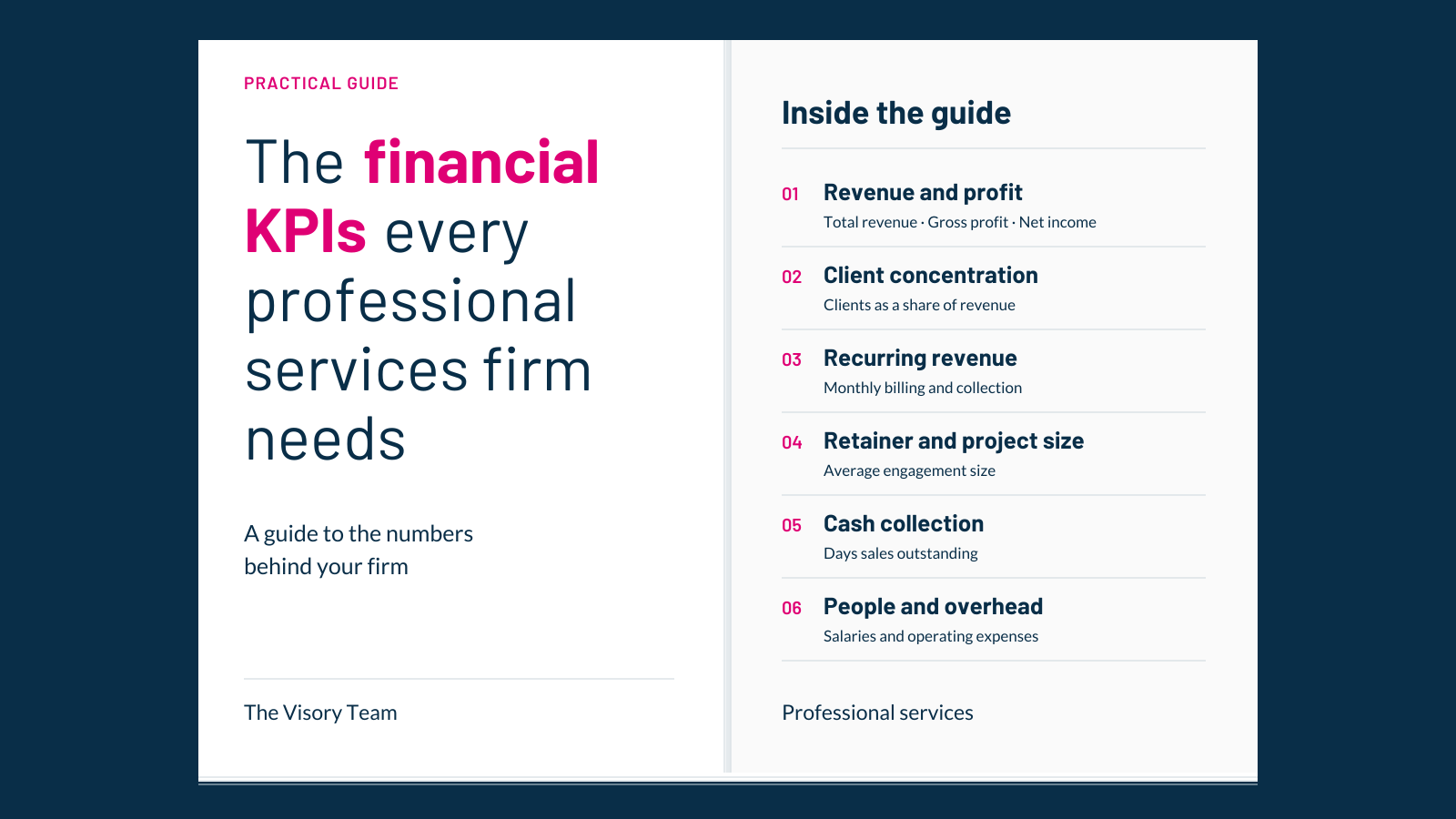
Content written for law firms by the expert teams at Visory.


Common questions
Straight answers for law firms.
The questions managing partners and founding attorneys ask before they hand Visory the finance function. The general ones are on the common questions page.
Do you do our trust accounting or IOLTA account?
No. Trust accounting, including IOLTA accounts, stays with your firm and its trust accounting specialist, because client trust accounts run under their own rules of professional conduct and need their own expertise. Under ABA Model Rule 1.15, client funds are held separate from the lawyer’s own property, and fees paid in advance go into a client trust account and come out only as they are earned. Visory runs the operating side of the books and reconciles fees from the point they reach your operating account.
What is lock-up, and how do you measure it?
Lock-up is the number of days of fees tied up between doing the work and banking the cash: work in progress days, for time recorded but not yet billed, plus days sales outstanding (DSO), for bills sent but not yet paid. Visory works it out each month from your ledger and your practice management reports, by partner, and sets it against the target your partners choose.
Can you track work in progress and unbilled time?
Yes, from the reports your practice management system already produces. Each month, aged work in progress is shown by partner and by matter, set against the fee agreed where you track one, and billed fees are tied back to the ledger. Matters with old unbilled time come to the top of the list.
How do you handle case costs?
Every cost your firm advances, from expert fees to filing fees and court reporters, is coded to the matter it belongs to when the bill is processed. Each month, paid costs are checked against what has been billed, so recoverable costs left off a bill are listed for the responsible partner before the matter closes.
Do our paralegals get paid overtime?
Usually, yes. Under federal wage regulations, paralegals and legal assistants generally do not qualify as exempt learned professionals, so unless another exemption fits, they are paid at least time and one-half for hours over 40 in a workweek. A licensed attorney who is practicing law is exempt, and the salary requirements do not apply. States can add their own rules: in California, overtime is also due after eight hours in a workday. Your Payroll Specialist records each role’s status as you set it, and Delphi AI checks every run against it. This is general information, not legal advice.
Will you follow up our unpaid bills?
Yes, in your name, on a cadence you agree. Visory sends the reminders, follows up by phone where you want it, and reports aged receivables by partner each week. In California, a client can ask for a bill and is owed one within 10 days, so billing records are kept current enough to answer. Collection actions and any fee dispute stay with the firm.
Can you show draws against profit for each partner?
Yes. Each month the read shows the firm’s profit for the month and the year to date beside the draws each partner has taken, so draws are set against profit earned rather than cash in the bank. For a professional corporation, the same view covers shareholder salaries and distributions.
Is our firm too small for this?
Usually not. A firm of five people still records time, bills matters, follows up receivables, and runs a payroll, and a partner doing the books after hours is time that is not being billed. Visory fits best from around five people; a solo attorney with no staff usually needs less.
How much does Visory cost?
Visory charges one flat monthly fee for the scope we agree. No timesheets, no hourly billing, no surprises. The fee reflects the services you take and the volume of work in your firm, from the number of bills sent and payments received to the size of the pay run, so you know the monthly cost before you start.
See how pricing works More questions, longer answers. Every question has its own link. See all common questions
General information for law firms, not financial or tax advice.
Getting started
Start with clarity, not a contract.
Three steps, in whatever rhythm suits you. Each one is useful on its own.
-

Book a discovery call
An obligation-free conversation about your matters, your billing rhythm, and what the partners want the numbers to tell them.
Obligation-free -

Get your free financial health check
A senior member of the Visory team analyzes your financials and shows where your finance function can improve. See the clarity before you commit to anything.
Free · your own numbers -

See how Visory works in practice
A walkthrough of the books, the pay run, and the monthly read on a firm like yours. If it fits, we agree a flat monthly scope.
Flat monthly fee
Get started
Walk into the partners’ meeting knowing where the fees are.
Start with a discovery call. Then a senior member of the Visory team runs the free financial health check on your own numbers and shows you where earned fees are waiting to become cash.
Sources (4) · rules last checked October 9, 2026
- American Bar Association, Model Rules of Professional Conduct, Rule 1.5(b): scope and basis or rate of the fee and expenses communicated, preferably in writing; Rule 1.5(c): contingent fee agreements in a writing signed by the client, and a written statement at the conclusion of the matter; Rule 1.15(a) and (c): client property held separate from the lawyer’s own, and advance fees deposited into a client trust account and withdrawn only as earned.
- California Business and Professions Code section 6148: written contract where total expense to a client will foreseeably exceed $1,000, its contents, bills on request within 10 days, voidability, and exceptions including a corporate client; section 6147: contingency fee contracts; both operative January 1, 2000, as amended by Stats. 1996, ch. 1104.
- Fair Labor Standards Act, section 7(a): overtime at not less than time and one-half for hours over 40 in a workweek; 29 CFR 541.304, practice of law, with the salary requirements not applying (541.304(d)); 29 CFR 541.301(e)(7), paralegals and legal assistants; part 541 published at 69 FR 22260, April 23, 2004.
- California Labor Commissioner’s Office, Overtime FAQ: overtime after eight hours in a workday or 40 hours in a workweek.