
Bookkeeping and payroll in South Carolina
Bookkeeping and payroll for South Carolina businesses.
Visory provides bookkeeping and payroll services for growing South Carolina businesses, from professional firms and consultancies to agencies. A dedicated team you know by name works inside your own QuickBooks or Xero file, with Delphi AI taking the repetitive parts under that team’s oversight, and keeps your books and pay runs to South Carolina’s sales tax, withholding, and unemployment insurance rules. One flat monthly fee covers the agreed scope.
- A dedicated team you know by name
- South Carolina rules in every pay run and close
- One flat monthly fee for the agreed scope

Who we work with in South Carolina
Growing businesses across South Carolina.
Retail trade employs about 269,000 people in South Carolina and manufacturing about 262,000, 1.4 times its share of jobs nationally (BLS Quarterly Census of Employment and Wages, 2025 annual averages). Across the state, private employers averaged about 1.95 million jobs in 2025.
- Services businesses with revenue of roughly $750k to $20m, led by a CEO, president, or founder.
- Nonprofits with grants, programs, and a board to report to.
- Franchise networks and payroll-heavy operations, with many sites and many pay runs.
- Professional services Professional, scientific, and technical services employ about 138,000 people in South Carolina in about 33,500 establishments, at average annual pay of $103,121 (BLS Quarterly Census of Employment and Wages, 2025).
- Architecture and design firms Architectural and engineering firms employ about 25,300 people in South Carolina, at average annual pay of $105,122, about two thirds above the state’s private-sector average (BLS Quarterly Census of Employment and Wages, 2025).
- Consulting firms About 7,000 management, scientific, and technical consulting firms employ about 24,300 people in South Carolina, at average annual pay of $100,932 (BLS Quarterly Census of Employment and Wages, 2025).
- Marketing and creative agencies Advertising, public relations, and related services employ about 6,300 people in South Carolina in about 1,950 establishments, at average annual pay of $76,150 (BLS Quarterly Census of Employment and Wages, 2025).
South Carolina rules
The South Carolina rules your finance function runs on.
Six rules set by South Carolina, each with the law that sets it and what it does to your month. Your team works to them every pay run and every close.
Deposits follow the federal schedule.
South Carolina withholding is paid over as often as federal withholding, so a business that deposits federal tax semiweekly does the same for the state, and each quarterly return has to agree with every deposit made.
Employers withhold South Carolina income tax using the 2026 formula in Form WH-1603F. After $5,000 for each allowance and, for employees claiming one or more, a standard deduction of 10% of wages up to $7,500, annual taxable income under $3,640 is taxed at 0%, income up to $18,230 at 3%, and the rest at 6%. Resident withholding agents pay with the same frequency as their federal deposits, and quarterly returns are due April 30, July 31, October 31, and January 31.
South Carolina Code Title 12, Chapter 8 (Income Tax Withholding); Form WH-1603F (Rev. 11/4/25); 2026 withholding tax formula, for wages paid in 2026.Sources SC Department of Revenue: Withholding SC Department of Revenue: WH-1603F, Formula for Computing South Carolina 2026 Withholding Tax South Carolina Legislature: Code of Laws Title 12, Chapter 8, Income Tax Withholding
The cost lands early in the year.
Tax stops once an employee’s wages pass $14,000, so for most salaried staff the year’s cost falls in the first quarter, and a budget that spreads it evenly understates January to March.
Employers pay unemployment insurance tax on the first $14,000 each employee earns. For 2026, total rates run from 0.06% to 5.46%, each including the 0.06% Departmental Administrative Contingency Assessment, and no solvency surcharge applies. New employers pay 1.06%, the 1% new-employer base rate plus the assessment, until they have 12 months of liability. Quarterly wage reports and tax are due April 30, July 31, October 31, and January 31.
South Carolina Code Title 41, Chapter 31 (Contributions and Payments to the Unemployment Trust Fund); 2026 tax rates, for wages paid January 1 to December 31, 2026.Sources SC Department of Employment and Workforce: Tax rate information (2026 rates) SC Department of Employment and Workforce: File a wage report SC Department of Employment and Workforce: Paying your tax South Carolina Legislature: Code of Laws Title 41, Chapter 31, Contributions and Payments to the Unemployment Trust Fund
The federal floor is the only floor.
With no state or city rate to track, every pay rate is checked against $7.25, and tipped staff against the $2.13 cash wage plus the tips recorded in each pay period.
South Carolina has no state minimum wage law, so employers subject to the federal Fair Labor Standards Act pay the federal minimum of $7.25 an hour. Tipped employees who receive more than $30 a month in tips may be paid a cash wage of $2.13, with a tip credit of up to $5.12, as long as their tips bring pay to at least $7.25 an hour.
Fair Labor Standards Act (federal); South Carolina has no minimum wage law; federal minimum wage of $7.25 effective July 24, 2009.Sources US Department of Labor: State minimum wage laws US Department of Labor: Minimum wage US Department of Labor: Minimum wages for tipped employees
Local tax follows the delivery address.
The county and city where a sale is delivered set the rate, not a mailing address, so the books record taxable sales by location to prepare the local schedule that goes with each return.
South Carolina’s 6% sales tax applies to retail sales of goods and certain services. Taxable services include communications such as telephone, fax, database access, streaming, and cloud-based services, and rentals of taxable property. Counties may add local taxes with voter approval, so combined rates run from 6% to 9%, set by where delivery occurs. Returns are due on the 20th of the month after each period, and quarterly or annual filing needs the Department of Revenue’s approval.
South Carolina Sales and Use Tax Act, Code Title 12, Chapter 36; combined rates in Form ST-575, revised February 5, 2026.Sources SC Department of Revenue: Sales tax SC Department of Revenue: ST-575, South Carolina Sales Tax Rate by Municipality (Rev. 2/5/26) South Carolina Legislature: Code of Laws Title 12, Chapter 36, Sales and Use Tax Act
The notice at hire sets the calendar.
The payday you put in writing becomes the rule you are held to, so it is set once in the payroll platform, and a leaver’s final pay is scheduled the day they go, not at month end.
South Carolina sets no fixed pay frequency: employers pay all wages due at the time and place they set at hiring. When an employee leaves the payroll for any reason, all wages due are paid within 48 hours or by the next regular payday, which may not be more than 30 days away. Unless they had fewer than five employees throughout the past 12 months, employers also give each employee an itemized statement of gross pay and deductions every pay period.
South Carolina Payment of Wages Act, Code §§ 41-10-30 to 41-10-50; final pay rule as amended, effective May 7, 1990.Source South Carolina Legislature: Code of Laws Title 41, Chapter 10, Payment of Wages
Onboarding is part of the first pay run.
The new-hire report and the written terms draw on the same details as the first pay, so both are done the day someone is added to the payroll file, and a new deduction is notified seven days before it starts.
Employers report each new hire who lives or works in South Carolina to the state directory of new hires, run by the Department of Social Services, within 20 calendar days, on Form W-4 or an equivalent giving the employee’s name, address, and Social Security number and the employer’s federal identification number. Unless they had fewer than five employees throughout the past 12 months, employers also give each new hire written terms: normal hours and wages, payday, and deductions, with any change other than a wage increase notified seven days ahead.
South Carolina Code § 43-5-598 (state directory of new hires); Payment of Wages Act, § 41-10-30; new hire reporting required from October 1, 1998.Sources South Carolina Legislature: Code of Laws Title 41, Chapter 10, Payment of Wages South Carolina Legislature: Code of Laws Title 43, Chapter 5, § 43-5-598, state directory of new hires
Rules last checked October 9, 2026 against the sources at the foot of this page. General information only. It does not take your circumstances into account.
How it works from anywhere
Can a team outside South Carolina run a South Carolina business?
Yes. Visory’s US leadership team is in New York, and its teams work with businesses across the United States remotely, inside your own accounting file, so nothing about the work depends on where your office is.
Your own file
Your books stay in your own QuickBooks or Xero file. Your team works inside it, so you see the same numbers they do, whenever you look.
A team you know by name
A dedicated team runs the work, led by a Business Performance Partner. You meet them by video call, and you always know who to ask.
South Carolina rules, built in
Visory runs the finance function for growing businesses across the United States, with its US leadership team in New York. Your books stay in your own QuickBooks or Xero file, and your team works inside it with you. Every pay run and every close is checked against the rules on this page.
Business hours, and the platform after them
Your team works 9am to 5pm Eastern Time on business days, all year round, and the Visory platform is open to you around the clock for documents, approvals, and your numbers.
What we run for South Carolina businesses
The whole finance function, actually handled.
Bookkeeping, payroll, accounts payable, and accounts receivable, run end to end by a dedicated team with Delphi AI working under their oversight. Flat monthly fee. No hourly billing.
Bookkeeping
Every transaction coded and reconciled, month-end closed on schedule.
Explore bookkeepingPayroll
Pay runs prepared, checked, and paid on time, every cycle.
See how payroll runsAccounts payable
Bills captured, checked against what's already paid, and paid when you say so.
See accounts payableAccounts receivable
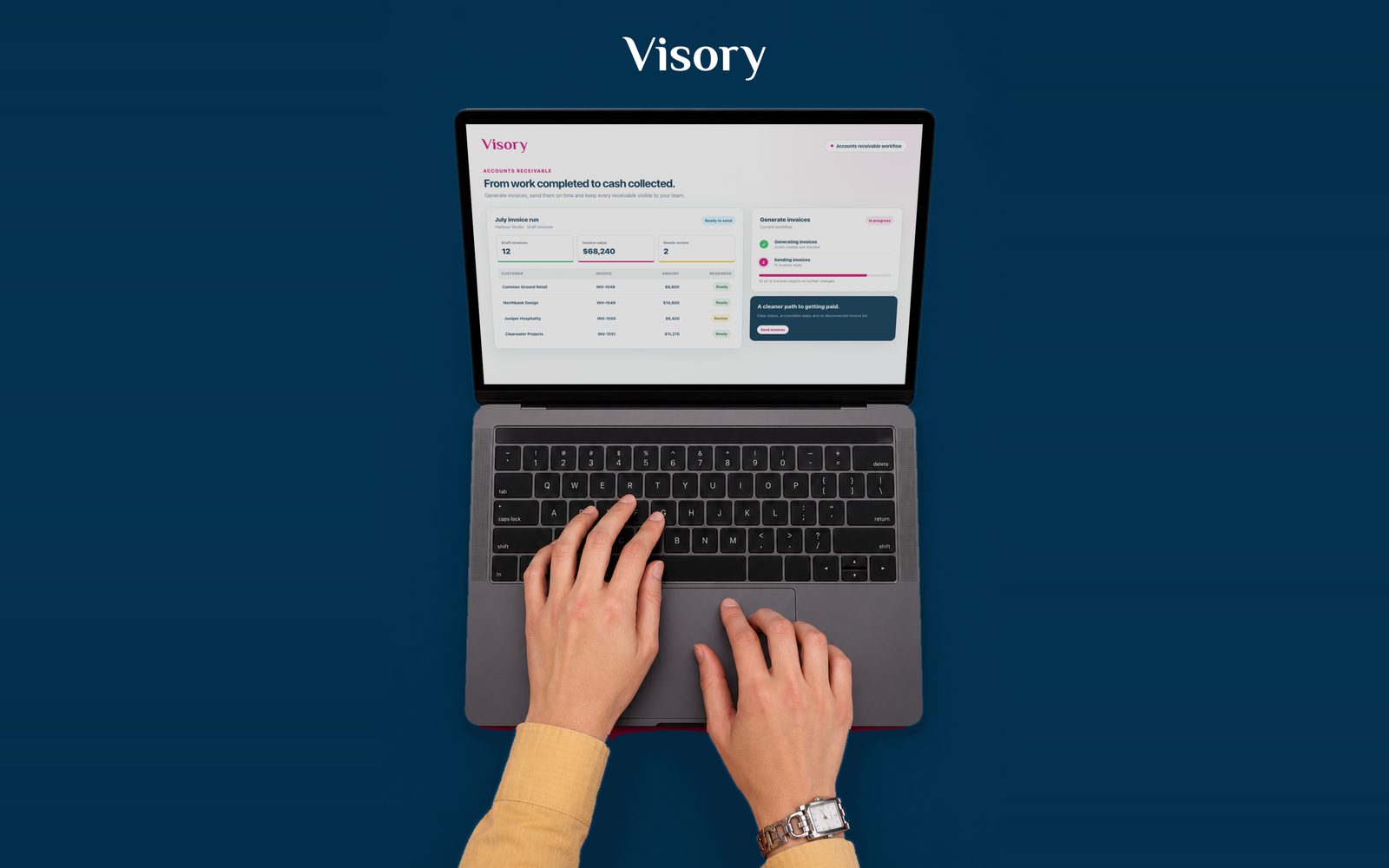
Invoices out on schedule, overdue accounts followed up in your name.
See accounts receivableVisory Insights
Once a month: what changed, what it means, and what to do next.
See how Insights worksBusiness Performance Partner
A named partner who walks you through the numbers and the next move.
How your partner worksVisory Insights
What your numbers should show in South Carolina.
Clean books are the start. Every month, Insights turns them into a plain-English report, and a named Business Performance Partner walks your leadership team through what they mean for the year ahead.
Unemployment tax accrues by March
At the 1.06% new-employer rate, each employee costs up to $148.40 in unemployment tax on the $14,000 wage base, and for anyone paid more than $56,000 a year, all of it falls in the first quarter. Insights puts that into the cash flow forecast.
Withholding follows the paycheck date
South Carolina counts withholding in the quarter of the paycheck date, not the pay period, so December work paid in January belongs on the next year’s first return, due April 30. Insights reports payroll cost by paycheck date, so the returns and the books agree.
Where you deliver sets the sales tax
Combined rates run from 6% to 9% depending on the county and city of delivery, so $10,000 of taxable services carries $600 of tax in one place and $900 in another. Insights shows the tax you hold by location, apart from the cash the business can use.
Looking for a fractional CFO in South Carolina? Visory has no standalone CFO offer. That work sits inside Visory Insights and your sessions with a Business Performance Partner. See Visory Insights
What customers say
In a customer’s words.
“Visory ensures we have a clear view of who we need to pay and how that impacts cash flow so that there are no surprises.”
 Rachelle Harper Co-founder and COO, BrandBossHQ
Common questions
Questions South Carolina businesses ask.
Straight answers about bookkeeping and payroll for a South Carolina business, from a team that works remotely.
Does Visory have an office in South Carolina?
Visory’s US leadership team is in New York, and its teams work with growing businesses across the United States remotely, so we support businesses in South Carolina as we do everywhere else. A South Carolina business gets a dedicated team you know by name, who keep the books and run payroll inside your own QuickBooks or Xero file and meet you by video call. Your records stay in your file, which you can open at any time.
What hours does my Visory team work?
Your team works 9am to 5pm Eastern Time on business days, all year round. Outside those hours, the Visory platform is your 24/7 access point, so your financial information is there whenever you need it.
Can a bookkeeper outside my office look after a South Carolina business?
Yes. What matters is that the team knows South Carolina’s rules and works inside your own accounting file. Visory connects to your bank feeds and software, codes and reconciles transactions through the month with Delphi AI working under an expert team, and meets you by video call. Nothing about the work depends on where your office is.
How much does a bookkeeper cost in South Carolina?
Visory charges one flat monthly fee for the scope we agree, with no hourly billing and no timesheets. The fee reflects the services you take, from bookkeeping and payroll to accounts payable, accounts receivable, and Insights, and the volume of work in your business. After a discovery call, you get a clear proposal, so you know the monthly cost before you start.
See how pricing works Do you work in QuickBooks and Xero?
Yes. Visory works inside the systems you already use: QuickBooks and Xero for the ledger, Gusto and Rippling for pay runs, and Bill, Ramp, and Stripe for payments, along with your bank feeds. Your books stay in your own accounting file, which you own and can open at any time. Any change to your setup is agreed with you first.
Do South Carolina businesses charge sales tax on services?
Only on certain services. The 6% sales tax applies to retail sales of goods and to services such as communications, including telephone, database access, streaming, and cloud-based services. Counties can add local taxes, so combined rates run from 6% to 9%, depending on where delivery occurs. This is general information; the Department of Revenue sets the rules for your business.
How much South Carolina income tax is withheld in 2026?
The 2026 formula taxes annual taxable income under $3,640 at 0%, income up to $18,230 at 3%, and the rest at 6%, after the allowances each employee claims on the SC W-4 and the standard deduction. Payments follow your federal deposit schedule, and your Payroll Specialist prepares the quarterly returns from the same pay runs. This is general information; the Department of Revenue sets the rules.
When is final pay due in South Carolina?
Within 48 hours of the employee leaving the payroll, or by the next regular payday, as long as that is no more than 30 days away. South Carolina sets no fixed pay frequency, so the payday you gave in writing at hiring is the one you keep, and your Payroll Specialist schedules final pay the day someone leaves. This is general information; the Department of Labor, Licensing and Regulation enforces the rules.
Can you look after staff in more than one state?
Yes. Each state sets its own income tax withholding, unemployment insurance, minimum wage, and leave rules, and South Carolina taxes wages earned in the state wherever the employee lives. Visory keeps one set of books and runs payroll with each state’s rules applied to the staff who work there, so every state’s cost shows in one monthly report.
Do you offer a fractional CFO in South Carolina?
A fractional CFO advises on numbers someone else produces. Visory runs the books, payroll, and payments, then delivers the insight from the same team: Visory Insights is a plain-English monthly report and a session with a named Business Performance Partner. There is no handover between the doing and the advising, and it comes on one flat monthly fee.
See how Visory Insights worksGetting started
Start with clarity, not a contract.
Three steps, in whatever rhythm suits you. Each one is useful on its own.
-

Book a discovery call
An obligation-free conversation about your goals and what you want the numbers to tell you.
Obligation-free -

Get your free financial health check
A senior member of the Visory team analyzes your financials and shows you where your finance function can improve. It is free, and it is your own numbers.
Free · your own numbers -
Receive a clear proposal
A clear commercial proposal for the scope we agree, on one flat monthly fee. No hourly billing. You decide whether to go ahead.
Flat monthly fee
Get started
The best is ahead for your business.
Start with a discovery call. We will listen first, then show you what your own numbers have been trying to tell you.
Sources (16) · rules last checked October 9, 2026
State income tax
Unemployment insurance
- SC Department of Employment and Workforce: Tax rate information (2026 rates)
- SC Department of Employment and Workforce: File a wage report
- SC Department of Employment and Workforce: Paying your tax
- South Carolina Legislature: Code of Laws Title 41, Chapter 31, Contributions and Payments to the Unemployment Trust Fund