

Payroll in Pennsylvania

Payroll services for Pennsylvania businesses.

Visory provides payroll services for Pennsylvania businesses with staff across the state. A dedicated Payroll Specialist runs each pay run remotely in your own payroll platform, applying the 3.07% state rate, the employee unemployment contribution, and the local earned income and services taxes for where each employee lives and works. Delphi AI takes the repetitive parts, overseen by the team. You approve each run before anyone is paid. One flat monthly fee.

  • A dedicated team you know by name
  • Pennsylvania rules in every pay run and close
  • One flat monthly fee for the agreed scope
Center City Philadelphia’s skyline in golden-hour light above the Schuylkill River and the Schuylkill River Trail boardwalk.
Photo: Alejandro Barba, Unsplash License

Payroll in Pennsylvania

What every Pennsylvania pay run covers.

A dedicated team prepares each pay run, checks it, and sends it to you to approve before anyone is paid. Six things are right every time.

  • Withholding, every run Federal withholding, and state and local taxes where they apply, worked out in every run from each employee’s own forms.
  • Filed on schedule Quarterly and annual payroll tax filings prepared from the same runs and filed on schedule by your payroll platform, so nothing is rebuilt at the deadline.
  • Unemployment insurance Pennsylvania contributions worked out on each employee’s wages, up to the state’s taxable wage base.
  • Leave that adds up Paid leave accrued in the file to your own policy and to city rules where they apply, so balances are right when someone asks.
  • Paid on the right day Pay frequency and final pay set to the state’s rules, and every run approved by you before anyone is paid.
  • New hires, set up properly New employees reported to the state and set up before their first pay run.

Pennsylvania rules

The Pennsylvania rules every pay run works to.

Six rules set by Pennsylvania, each with the law that sets it and what it does to your month. Your team works to them every pay run and every close.

One flat rate, four payment calendars.

The rate never changes with pay, but the deposit schedule does: a business withholding $5,000 or more a quarter pays semi-weekly, within days of each payday, so each payment is reconciled to its payroll as it goes.

Set by Pennsylvania personal income tax, employer withholding

Employers withhold Pennsylvania personal income tax at a flat 3.07% of compensation from residents and from nonresidents earning income in Pennsylvania. How often it is paid depends on quarterly withholding: under $300 is paid quarterly, $300 to $999 monthly by the 15th of the next month, $1,000 to $4,999.99 semi-monthly within three banking days, and $5,000 or more semi-weekly. Employers also file a quarterly withholding return, Form W-3.

Pennsylvania personal income tax, employer withholding.

Two contributions with different shapes.

The employer’s stops at $10,000 of wages, so it lands early in the year, while the employee’s 0.07% comes out of every paycheck, so both are tracked separately in each quarterly report.

Set by Pennsylvania Unemployment Compensation Law

Employers pay contributions on the first $10,000 of each employee’s wages, the base in force since 2018. A new non-construction employer pays a total rate of 3.8220% for its first two or three years, or 10.5924% in construction. Employers also withhold employee contributions of 0.07% of total gross wages, with no wage cap. Quarterly reports and contributions are due April 30, July 31, October 31, and January 31.

Pennsylvania Unemployment Compensation Law; wage base from 2018; new-employer and employee rates for 2023 and thereafter.

Tip credits need tip records.

A tipped employee can be paid $2.83 an hour only while tips reach $135 a month and cover the gap to $7.25, so the payroll file records tips each period and tops up any shortfall.

Set by Pennsylvania Minimum Wage Act

Pennsylvania’s minimum wage is $7.25 an hour, in effect since July 24, 2009, with overtime at 1.5 times the regular rate after 40 hours in a workweek. Tipped employees may be paid a cash wage of $2.83 an hour if they receive at least $135 a month in tips, and the employer makes up the difference when tips and the cash wage fall short of $7.25. Employers keep accurate records of each employee’s earnings and hours.

Pennsylvania Minimum Wage Act; $7.25 rate effective July 24, 2009.

Staffing and office services can carry tax.

A business selling help supply, secretarial, or cleaning services collects 6% to 8% on the invoice and holds it for the state, so the books keep tax collected apart from fee income until each return is paid.

Set by Pennsylvania sales and use tax (72 P.S. §§ 7201 and 7217); REV-717

Pennsylvania’s 6% sales tax applies to goods and to specific business services, including lobbying; adjustment, collection, and credit reporting; secretarial and editing; employment agency and help supply; building maintenance and cleaning; disinfecting and pest control; and lawn care. A 1% local tax is added in Allegheny County and 2% in Philadelphia. Monthly returns, due the 20th, apply once tax passes $600 a quarter; smaller liabilities file quarterly or semiannually.

Pennsylvania sales and use tax (72 P.S. §§ 7201 and 7217); REV-717.

The schedule you set is the one you keep.

The law holds you to the pay rate and payday you have communicated, so a change to either is notified before it takes effect, and a leaver’s final pay runs on the next scheduled payday, whatever the reason they left.

Set by Pennsylvania Wage Payment and Collection Law

Pennsylvania’s Wage Payment and Collection Law requires employers to pay employees the pay rate and on the schedule they have communicated, and deductions other than taxes need the employee’s written authorization. Each pay period, employees get a pay stub showing hours worked, rate of pay, gross wages, deductions, and the dates of the pay period. When someone quits, is laid off, or is fired, all wages earned are due by the next scheduled payday.

Pennsylvania Wage Payment and Collection Law.

Onboarding sets the local tax rate.

The residency form decides which local earned income tax rate comes out of the first pay, so it is collected the day someone is added to the payroll file, along with the new-hire report.

Set by 23 Pa.C.S. § 4392(d); Act 32 Residency Certification Form

Employers report every newly hired or rehired employee to the Commonwealth’s New Hire Reporting Program within 20 days of the hire date, under 23 Pa.C.S. § 4392(d), through the PA CareerLink website, by secure file transfer, mail, or fax. For local earned income tax, each new employee also completes a Residency Certification Form at hire, giving the codes for where they live and work.

23 Pa.C.S. § 4392(d); Act 32 Residency Certification Form.

Rules last checked October 9, 2026 against the sources at the foot of this page. General information only. It does not take your circumstances into account.

Local rules

Where the rules change across Pennsylvania.

Your team applies the local rules as well as the Pennsylvania ones. These are the places where a local tax, a wage rate, or a leave law differs from the rest of the state.

Independence Hall in Philadelphia, its red-brick front and white clock tower under a clear blue sky.
Photo: Ernie Journeys, Unsplash License

Philadelphia

Philadelphia adds its own Wage Tax on residents and on nonresidents who work there, a paid sick leave law, and the highest sales tax rate.

  • From July 1, 2026, Wage Tax is withheld at 3.735% from all wages of city residents, wherever they work, and 3.425% from nonresidents for work in Philadelphia. Returns are quarterly, and payments run quarterly, monthly, semi-monthly, or weekly by the amount withheld.
  • Employers with 10 or more employees provide paid sick leave, and smaller employers unpaid leave: employees earn 1 hour for every 40 worked, up to 40 hours a calendar year, and records are kept for three years.
  • Sales tax in Philadelphia is 8%, the 6% state rate plus a 2% local tax.

Downtown Pittsburgh and Point State Park where the rivers meet, in autumn color, seen from the hills to the south.
Photo: Tyler Rutherford, Unsplash License

Pittsburgh

Pittsburgh adds a resident earned income tax, an employer payroll expense tax, and a local services tax withheld from employees.

  • City residents have 3% earned income tax withheld, 1% for the city and 2% for the school district, whether their employer is inside or outside Pittsburgh.
  • Employers with staff working in the city pay the Payroll Expense Tax of 0.55% on total payroll for that work, filed quarterly by the last day of the second month after each quarter.
  • Employers withhold the $52 Local Services Tax evenly through the year and report it each quarter, and sales tax in Allegheny County is 7%.

Municipalities statewide

Local earned income tax rates differ by municipality, and employers withhold the higher of the home rate and the work location rate.

  • For each employee, the employer compares the Total Resident EIT Rate where they live with the Work Location Non-Resident EIT Rate where they work, and withholds the higher of the two.
  • Each employee completes a Residency Certification Form at hire with six-digit PSD codes, and the employer remits the tax, with the Local Services Tax, to the tax collector for the worksite.
  • An employee who lives outside Pennsylvania has a resident rate of 0% but still owes the work location’s nonresident rate and the Local Services Tax.

How it works from anywhere

Can a team outside Pennsylvania run a Pennsylvania business?

Yes. Visory’s US leadership team is in New York, and its teams work with businesses across the United States remotely, inside your own accounting file, so nothing about the work depends on where your office is.

Your own file

Your books stay in your own QuickBooks or Xero file. Your team works inside it, so you see the same numbers they do, whenever you look.

A team you know by name

A dedicated team runs the work, led by a Business Performance Partner. You meet them by video call, and you always know who to ask.

Pennsylvania rules, built in

Visory runs the finance function for growing businesses across the United States, with its US leadership team in New York. Your books stay in your own QuickBooks or Xero file, and your team works inside it with you. Every pay run and every close is checked against the rules on this page.

Business hours, and the platform after them

Your team works 9am to 5pm Eastern Time on business days, all year round, and the Visory platform is open to you around the clock for documents, approvals, and your numbers.

What customers say

In a customer’s words.

“I have enough people to manage, so it's nice having a partner that ensures nothing is missed when it comes to the very important process of remunerating our people.”

Rachelle Harper Co-founder and COO, BrandBossHQ

Common questions

Questions Pennsylvania businesses ask.

Straight answers about payroll for a Pennsylvania business, from a team that works remotely.

What does a Visory pay run for a Pennsylvania business include?

Your Payroll Specialist runs each pay run, with Delphi AI preparing and checking it in the background, and you approve it before anyone is paid. The Payroll Specialist handles new hires, leave, changes, and terminations, applies Pennsylvania withholding, local earned income tax, and Philadelphia Wage Tax where each applies, and posts the run to your books, so wages, deductions, and leave balances agree every month.

What hours does my payroll team work?

Your payroll team works 9am to 5pm Eastern Time on business days, all year round. Outside those hours, the Visory platform is your 24/7 access point, so your payroll information is there whenever you need it.

How often do I have to pay employees in Pennsylvania?

On the pay schedule you have communicated to them. The Wage Payment and Collection Law holds employers to the rate and schedule they set, and anyone who quits, is laid off, or is fired is paid all wages earned by the next scheduled payday. Each pay period also comes with a pay stub showing hours, rate, and deductions. This is general information; the Department of Labor and Industry sets the rules.

What do I have to do when I hire someone in Pennsylvania?

Report the new employee to the Commonwealth’s New Hire Reporting Program within 20 days of the hire date, through PA CareerLink or another approved method, and have them complete a Residency Certification Form, which sets their local earned income tax rate. Your Payroll Specialist does both when the employee is set up, before the first pay run.

When is Pennsylvania withholding paid over?

It depends on how much is withheld each quarter at the flat 3.07% rate: under $300, quarterly by the last day of April, July, October, and January; $300 to $999, monthly by the 15th of the next month; $1,000 to $4,999.99, semi-monthly within three banking days of each period’s close; and $5,000 or more, semi-weekly, on the Wednesday or Friday after each payday. Employers also file a quarterly withholding return, Form W-3. This is general information; the Department of Revenue sets the rules.

What is the Pennsylvania unemployment compensation wage base?

Employer contributions are paid on the first $10,000 of each employee’s wages, and a new non-construction employer pays a total rate of 3.8220%. Employees also contribute 0.07% of all their gross wages, which the employer withholds. Your Payroll Specialist prepares the quarterly report from the same pay runs, due April 30, July 31, October 31, and January 31.

What is the minimum wage in Pennsylvania?

It is $7.25 an hour, in effect since July 24, 2009, with overtime at 1.5 times the regular rate after 40 hours a week. Tipped employees may be paid $2.83 an hour if they receive at least $135 a month in tips, with the employer making up any shortfall. This is general information; the Department of Labor and Industry sets the rules.

Do Philadelphia employers have to provide paid sick leave?

Employers with 10 or more employees must provide paid sick leave, and those with nine or fewer must provide unpaid sick leave. Employees earn one hour for every 40 hours worked, up to 40 hours a calendar year, and every employer keeps records of accrual and use for three years. This is general information; the City of Philadelphia sets the rules.

Which Pittsburgh taxes come out of payroll?

Employees who live in the city have 3% earned income tax withheld wherever their employer is, and employees working in the city have the $52 Local Services Tax deducted evenly through the year. The employer also pays the 0.55% Payroll Expense Tax on payroll for work in the city. This is general information; the City of Pittsburgh Department of Finance sets the rules.

More questions, longer answers. Every question has its own link. See all common questions

Getting started

Start with clarity, not a contract.

Three steps, in whatever rhythm suits you. Each one is useful on its own.

  1. Two people shake hands across a desk beside a laptop

    Book a discovery call

    An obligation-free conversation about your goals and what you want the numbers to tell you.

    Obligation-free
  2. A woman takes notes beside a laptop showing a financial report

    Get your free financial health check

    A senior member of the Visory team analyzes your financials and shows you where your finance function can improve. It is free, and it is your own numbers.

    Free · your own numbers
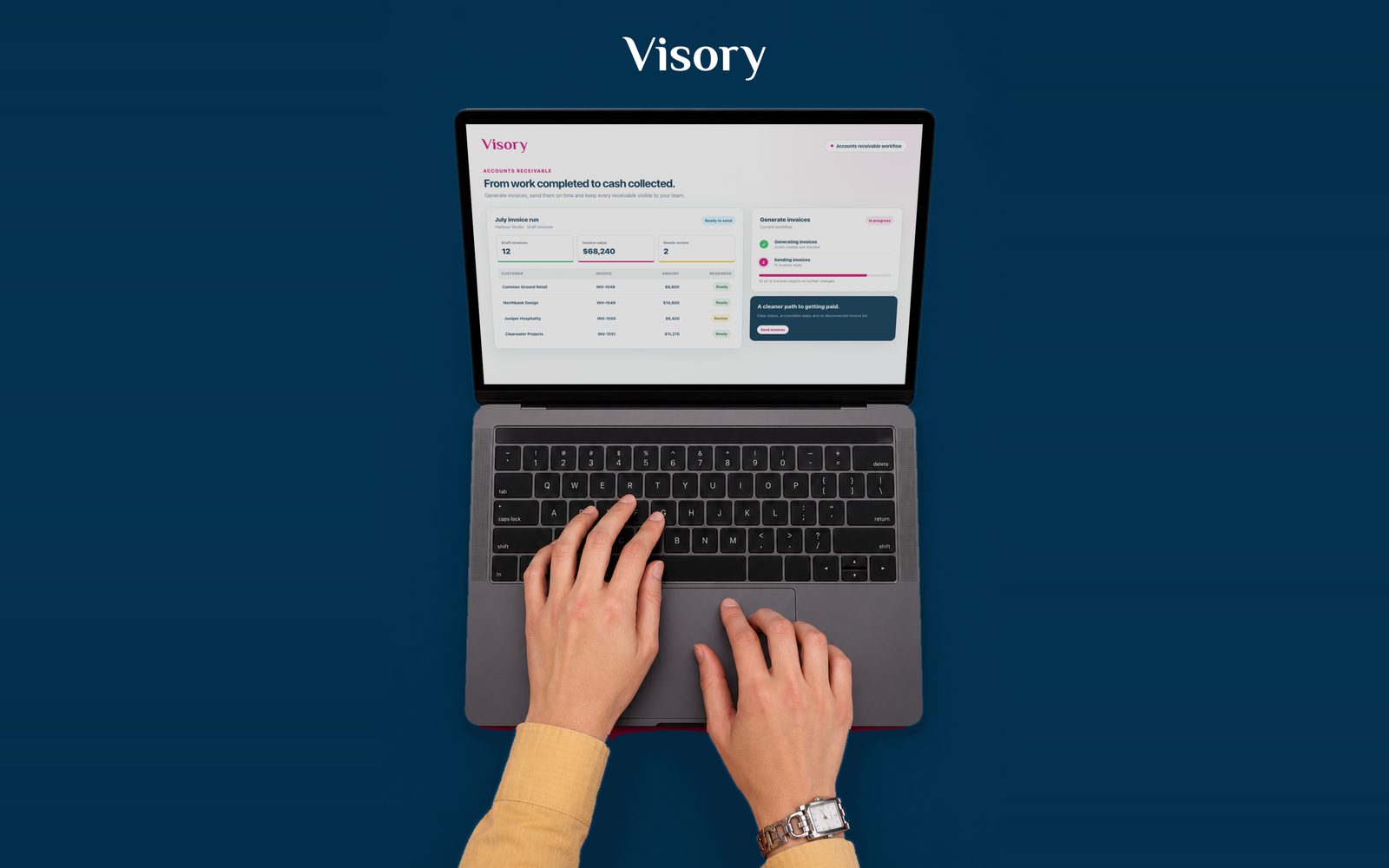
  3. Top-down view of hands on a laptop showing the Visory accounts receivable workflow

    Receive a clear proposal

    A clear commercial proposal for the scope we agree, on one flat monthly fee. No hourly billing. You decide whether to go ahead.

    Flat monthly fee

Get started

The best is ahead for your business.

Start with a discovery call. We will listen first, then show you what your own numbers have been trying to tell you.

Sources (18) · rules last checked October 9, 2026

A different Visory region may suit you

You’re viewing Visory US. Would you like to visit Visory AU?