

Payroll in Illinois

Payroll services for Illinois businesses.

Visory provides payroll services for Illinois businesses with staff across the state. A dedicated Payroll Specialist runs each pay run remotely in your own payroll platform, handling state withholding, the Chicago and Cook County minimum wage and paid leave rules, and the report every new hire needs. Delphi AI takes the repetitive parts, overseen by the team. You approve each run before anyone is paid. One flat monthly fee.

  • A dedicated team you know by name
  • Illinois rules in every pay run and close
  • One flat monthly fee for the agreed scope
Chicago’s Gold Coast towers and the former John Hancock Center along the Lake Michigan shore.
Photo: Ricky Beron, Unsplash License

Payroll in Illinois

What every Illinois pay run covers.

A dedicated team prepares each pay run, checks it, and sends it to you to approve before anyone is paid. Six things are right every time.

  • Withholding, every run Federal withholding, and state and local taxes where they apply, worked out in every run from each employee’s own forms.
  • Filed on schedule Quarterly and annual payroll tax filings prepared from the same runs and filed on schedule by your payroll platform, so nothing is rebuilt at the deadline.
  • Unemployment insurance Illinois contributions worked out on each employee’s wages, up to the state’s taxable wage base.
  • Leave that adds up Paid leave accrued in the file to the state’s rules, so balances are right when someone asks.
  • Paid on the right day Pay frequency and final pay set to the state’s rules, and every run approved by you before anyone is paid.
  • New hires, set up properly New employees reported to the state and set up before their first pay run.

Illinois rules

The Illinois rules every pay run works to.

Seven rules set by Illinois, each with the law that sets it and what it does to your month. Your team works to them every pay run and every close.

The $12,000 line changes the payment rhythm.

Once withholding passes it in a quarter, payments move from monthly to semi-weekly from the next quarter, due days after each payroll, so payroll and the books are reconciled every pay run rather than every month.

Set by Illinois Income Tax Act; Booklet IL-700-T (R-12/25)

Employers withhold Illinois income tax at a flat 4.95% of wages after subtracting allowances, using Booklet IL-700-T, with an exemption allowance of $2,925 for 2026. Withholding is paid monthly, by the 15th of the next month, or semi-weekly once more than $12,000 was withheld in the look-back period or in a quarter. Form IL-941 is filed quarterly, by the last day of the month after each quarter, and Illinois has no annual reconciliation return.

Illinois Income Tax Act; Booklet IL-700-T (R-12/25); withholding tables effective January 1, 2026.

The cost lands in the first quarter.

Contributions stop once wages pass $14,250, so for staff paid well above that, nearly the whole year’s cost goes out with the April report, and a budget that spreads it evenly overstates the rest of the year.

Set by Illinois Unemployment Insurance Act, 820 ILCS 405

Contributions are paid on the first $14,250 of each worker’s wages in 2026, up from $13,916 in 2025. Most new employers pay the entry rate of 3.350%, or 3.450% in administrative support and waste management. Experience-rated employers pay from 0.750% to 7.050%, and every rate includes the 0.550% fund building rate. Form UI-3/40 and contributions are due by April 30, July 31, October 31, and January 31.

Illinois Unemployment Insurance Act, 820 ILCS 405; 2026 contribution rates and wage base, for calendar year 2026.

The rate follows the work location.

A business with staff in Chicago, in suburban Cook County, and downstate pays three different floors, and the city and county rates move every July 1, so each employee’s work location in the payroll file decides which applies.

Set by Illinois Minimum Wage Law, 820 ILCS 105

The Illinois minimum wage is $15.00 an hour for workers 18 and older, unchanged on January 1, 2026. Employers of tipped workers may pay 60% of it, $9.00, and workers under 18 working fewer than 650 hours a year are paid at least $13.00. From July 1, 2026, Chicago sets $17.05 for employers with 4 or more employees, and Cook County sets $15.40.

Illinois Minimum Wage Law, 820 ILCS 105; state rate since January 1, 2025, unchanged on January 1, 2026; Chicago and Cook County rates from July 1, 2026.

The service is untaxed, the items are not.

A business that transfers printed, built, or supplied items as part of its service owes tax on those items, and stating their selling price separately on the invoice keeps the tax to the items rather than to half the bill.

Set by Retailers’ Occupation Tax Act, 35 ILCS 120; Service Occupation Tax Act, 35 ILCS 115

Illinois taxes sales of general merchandise at 6.25%, plus locally imposed taxes that vary by location. The service component of a sale of service is not taxable: Service Occupation Tax applies only to tangible personal property transferred as part of the service, and from January 1, 2026 some of those transfers are taxed at the rate where the purchaser receives them. Form ST-1 is due by the 20th of the month after each monthly, quarterly, or annual period.

Retailers’ Occupation Tax Act, 35 ILCS 120; Service Occupation Tax Act, 35 ILCS 115; Service Occupation Tax changes effective January 1, 2026.

Three leave regimes, one payroll file.

Staff in Chicago, suburban Cook County, and the rest of the state accrue under different rules, so each balance follows the employee’s work location, and leave kept in a vacation or paid time off bank can have to be paid out when they leave.

Set by Paid Leave for All Workers Act, 820 ILCS 192

Workers earn one hour of paid leave for every 40 hours worked, up to 40 hours a year, and can use it for any reason, without giving one, after 90 days of employment. Unused leave carries over, but an employer need not allow more than 40 hours of use in a year. The Act covers employers of all sizes, including nonprofits, but not Chicago or Cook County, which have ordinances of their own.

Paid Leave for All Workers Act, 820 ILCS 192; in effect from January 1, 2024.

Vacation balances are wages at the end.

Earned vacation is part of final compensation, so a leaver’s balance is valued and paid on the next regular payday, and the leave records need to be right before notice is given, not after.

Set by Illinois Wage Payment and Collection Act, 820 ILCS 115

Employers pay all wages earned at least semi-monthly, no later than 13 days after the end of the pay period in which they were earned. Executive, administrative, and professional employees as defined under the federal Fair Labor Standards Act, and commissions, may be paid once a month. Final compensation, including earned bonuses, commissions, and vacation pay, is due by the next regularly scheduled payday.

Illinois Wage Payment and Collection Act, 820 ILCS 115.

Onboarding is part of the pay run.

The new-hire report draws on the same details as the first pay, so it is prepared when someone is set up in the payroll file, and a Chicago hire also gets the city’s rights notice with the first paycheck.

Set by Illinois New Hire Directory reporting requirement

All employers report new employees to the Illinois New Hire Directory within 20 days of the employee’s first day on the payroll. The report gives the employee’s name, home address, Social Security number, and date of hire, meaning the first day of work for pay, with the employer’s name, address, and federal employer identification number, and optionally an address for income withholding orders.

Illinois New Hire Directory reporting requirement.

Rules last checked October 9, 2026 against the sources at the foot of this page. General information only. It does not take your circumstances into account.

Local rules

Where the rules change across Illinois.

Your team applies the local rules as well as the Illinois ones. These are the places where a local tax, a wage rate, or a leave law differs from the rest of the state.

The Chicago River running between downtown towers, seen from Wolf Point, with a bridge and boats on the water.
Photo: Frederick Wallace, Unsplash License

Chicago

The city sets a higher minimum wage and its own paid leave ordinance, which applies in place of the state law.

  • The Chicago minimum wage is $17.05 an hour from July 1, 2026, for employers with 4 or more employees, and $12.96 for tipped workers. It rises each July 1 by the Consumer Price Index or 2.5%, whichever is lower.
  • Covered employees accrue one hour of paid leave and one hour of paid sick leave for every 35 hours worked, up to 40 hours of each a year. Employers with 51 or more covered employees pay out accrued paid leave at separation.
  • With the first paycheck, and annually with a paycheck issued within 30 days of July 1, every employer gives covered employees a notice of the current minimum wage and their paid leave and paid sick leave rights.


Suburban Cook County

Outside Chicago, Cook County sets its own minimum wage and a paid leave ordinance that applies instead of the state law.

  • The Cook County minimum wage is $15.40 an hour from July 1, 2026, and $9.25 for tipped employees. Some municipalities have opted out, so the city, village, or township decides which rate applies.
  • The Cook County Paid Leave Ordinance, in effect since December 31, 2023, requires at least one hour of paid leave for every 40 hours worked, usable for any reason.
  • Leave credited to a paid time off bank or vacation account is paid out within 15 days of termination, resignation, or retirement; unused leave kept separately as sick leave does not have to be paid out.

How it works from anywhere

Can a team outside Illinois run an Illinois business?

Yes. Visory’s US leadership team is in New York, and its teams work with businesses across the United States remotely, inside your own accounting file, so nothing about the work depends on where your office is.

Your own file

Your books stay in your own QuickBooks or Xero file. Your team works inside it, so you see the same numbers they do, whenever you look.

A team you know by name

A dedicated team runs the work, led by a Business Performance Partner. You meet them by video call, and you always know who to ask.

Illinois rules, built in

Visory runs the finance function for growing businesses across the United States, with its US leadership team in New York. Your books stay in your own QuickBooks or Xero file, and your team works inside it with you. Every pay run and every close is checked against the rules on this page.

Business hours, and the platform after them

Your team works 9am to 5pm Eastern Time on business days, all year round, and the Visory platform is open to you around the clock for documents, approvals, and your numbers.

What customers say

In a customer’s words.

“I have enough people to manage, so it's nice having a partner that ensures nothing is missed when it comes to the very important process of remunerating our people.”

Rachelle Harper Co-founder and COO, BrandBossHQ

Common questions

Questions Illinois businesses ask.

Straight answers about payroll for an Illinois business, from a team that works remotely.

What does a Visory pay run for an Illinois business include?

Your Payroll Specialist runs each pay run, with Delphi AI preparing and checking it in the background, and you approve it before anyone is paid. The Payroll Specialist handles new hires, leave, changes, and terminations, applies Illinois withholding and the Chicago and Cook County rules where each applies, and posts the run to your books, so wages, deductions, and leave balances agree every month.

What hours does my payroll team work?

Your payroll team works 9am to 5pm Eastern Time on business days, all year round. Outside those hours, the Visory platform is your 24/7 access point, so your payroll information is there whenever you need it.

How often do I have to pay employees in Illinois?

At least twice a month, no later than 13 days after the end of each pay period. Executive, administrative, and professional employees under the federal Fair Labor Standards Act, and commissions, may be paid monthly. Final compensation, including earned vacation, bonuses, and commissions, is due by the next regular payday. This is general information; the Illinois Department of Labor sets the rules.

How does paid leave work for Chicago employees?

Employees who work at least 80 hours in any 120-day period in Chicago accrue one hour of paid leave and one hour of paid sick leave for every 35 hours worked, up to 40 hours of each a year. Employers with 51 or more covered employees pay out accrued paid leave at separation. This is general information; the Chicago Office of Labor Standards sets the rules.

What do I have to do when I hire someone in Illinois?

Report the new employee to the Illinois New Hire Directory within 20 days of their first day on the payroll, with their name, home address, Social Security number, and date of hire. In Chicago, the employee also gets the city’s minimum wage and paid leave notice with the first paycheck. Your Payroll Specialist does both when the employee is set up.

What is the Illinois unemployment insurance wage base in 2026?

Contributions are paid on the first $14,250 of each worker’s wages in 2026, up from $13,916 in 2025. Most new employers pay 3.350%, and experience-rated employers pay from 0.750% to 7.050%, including the 0.550% fund building rate. Your Payroll Specialist prepares the quarterly Form UI-3/40 from the same pay runs, due a month after each quarter ends.

What is the minimum wage in Illinois?

The Illinois minimum wage is $15.00 an hour for workers 18 and older, with 60% of it, $9.00, for tipped workers and $13.00 for workers under 18 working fewer than 650 hours a year. From July 1, 2026, Chicago sets $17.05 for employers with 4 or more employees, and Cook County sets $15.40 where a municipality has not opted out. Your Payroll Specialist applies the rate for each employee’s work location in every pay run. This is general information; the Illinois Department of Labor, the City of Chicago, and Cook County set their rules.

When is Illinois income tax withholding paid over?

New employers pay monthly, by the 15th of the month after the tax was withheld. Employers that withheld more than $12,000 in the look-back period, or pass $12,000 in a quarter, pay semi-weekly, generally three to seven days after each payroll. Form IL-941 is filed quarterly. This is general information; the Illinois Department of Revenue sets the rules.

More questions, longer answers. Every question has its own link. See all common questions

Getting started

Start with clarity, not a contract.

Three steps, in whatever rhythm suits you. Each one is useful on its own.

  1. Two people shake hands across a desk beside a laptop

    Book a discovery call

    An obligation-free conversation about your goals and what you want the numbers to tell you.

    Obligation-free
  2. A woman takes notes beside a laptop showing a financial report

    Get your free financial health check

    A senior member of the Visory team analyzes your financials and shows you where your finance function can improve. It is free, and it is your own numbers.

    Free · your own numbers
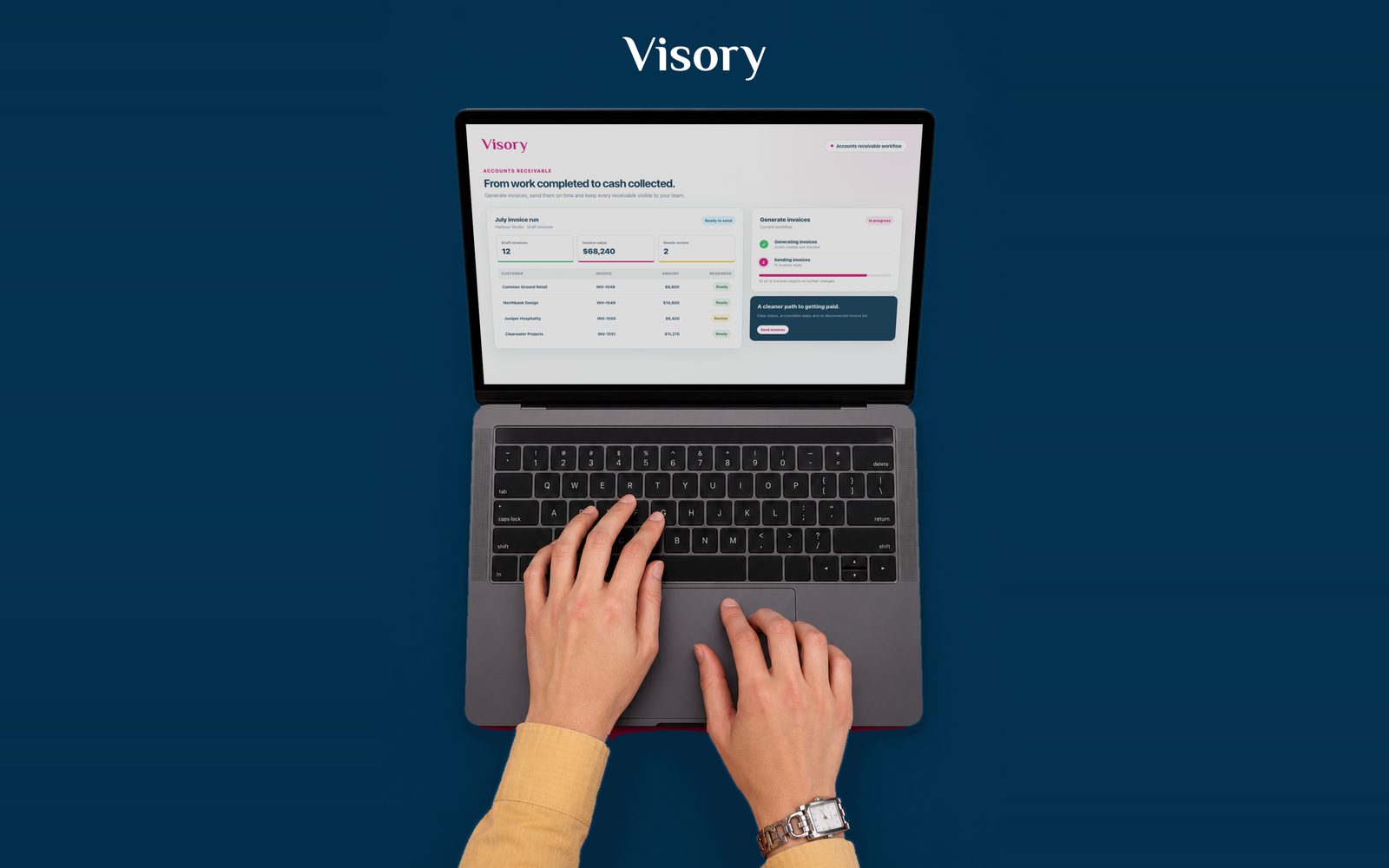
  3. Top-down view of hands on a laptop showing the Visory accounts receivable workflow

    Receive a clear proposal

    A clear commercial proposal for the scope we agree, on one flat monthly fee. No hourly billing. You decide whether to go ahead.

    Flat monthly fee

Get started

The best is ahead for your business.

Start with a discovery call. We will listen first, then show you what your own numbers have been trying to tell you.

Sources (22) · rules last checked October 9, 2026

A different Visory region may suit you

You’re viewing Visory US. Would you like to visit Visory AU?