

Bookkeeping and payroll in Wisconsin

Bookkeeping and payroll for Wisconsin businesses.

Visory provides bookkeeping and payroll services for growing Wisconsin businesses, from professional firms and consultancies to nonprofits. A dedicated team you know by name works inside your own QuickBooks or Xero file, with Delphi AI taking the repetitive parts under that team’s oversight, and keeps your books and pay runs to Wisconsin’s withholding, unemployment insurance, and sales tax rules. One flat monthly fee covers the agreed scope.

  • A dedicated team you know by name
  • Wisconsin rules in every pay run and close
  • One flat monthly fee for the agreed scope
Downtown Milwaukee at sunrise, with the winged Milwaukee Art Museum and the lakefront parks along Lake Michigan.
Photo: Tom Barrett, Unsplash License

Who we work with in Wisconsin

Growing businesses across Wisconsin.

Manufacturing is Wisconsin’s largest private industry, with about 458,000 jobs, nearly twice its share of jobs nationally, ahead of health care and social assistance at about 430,000, and machinery makers employ about 63,500, three times the national share (BLS Quarterly Census of Employment and Wages, 2025 annual averages). Across the state, private employers averaged 2.56 million jobs in 2025.

Wisconsin rules

The Wisconsin rules your finance function runs on.

Six rules set by Wisconsin, each with the law that sets it and what it does to your month. Your team works to them every pay run and every close.

The pay date sets the deposit date.

Withholding is owed when wages are paid, not when they are earned, so pay dated the 15th and pay dated the 16th can fall due two weeks apart, and the books record each deposit against the pay runs it covers.

Set by Wisconsin Statutes chapter 71; Publication W-166 (1/26)

Employers withhold Wisconsin income tax using the tables or formula in Publication W-166, which run from 3.54% to 7.65% on annual net wages over $280,950. Supplemental wages such as bonuses may instead be withheld at flat rates from 3.54% to 7.65%, set by estimated annual salary. The department assigns annual, quarterly, monthly, or semimonthly deposits. Monthly and quarterly reports are due the last day of the following month; semimonthly filers pay by month end for pay dates from the 1st to the 15th, and by the 15th of the next month for later ones.

Wisconsin Statutes chapter 71; Publication W-166 (1/26); withholding tables for withholding periods beginning on or after January 1, 2022.

The cost lands early in the year.

Contributions stop once an employee earns $14,000, so for salaried staff most of the year’s cost falls in the first quarter, and a budget that spreads it evenly understates January to March.

Set by Wisconsin Statutes chapter 108, § 108.18

Employers pay unemployment insurance contributions on the first $14,000 of each employee’s wages in a calendar year. Schedule D is in effect for 2026, with total rates from 0.00% to 12.00%; new employers pay 3.05%, or 3.25% with payroll of $500,000 or more, and new construction employers 2.50% or 2.70%. Schedule D and the general new-employer rates carry into 2027. Quarterly contribution reports are due April 30, July 31, October 31, and January 31.

Wisconsin Statutes chapter 108, § 108.18; Schedule D rates for 2026; the $14,000 wage base applies to each calendar year.

Tipped pay is checked each pay period.

For staff on the $2.33 cash wage, the payroll file compares wages plus tips with $7.25 an hour for every pay period, and any shortfall is paid in that run, not at year end.

Set by Wisconsin Statutes chapter 104; Wisconsin Administrative Code DWD 272

The Wisconsin minimum wage is $7.25 an hour for adults and minors, the same as the federal rate. Tipped employees may be paid $2.33 an hour, but if tips and wages do not average at least $7.25 an hour over the pay period, the employer makes up the difference. Employees under 20 may be paid an opportunity wage of $5.90 for their first 90 consecutive calendar days of employment, or until they turn 20 if that comes first.

Wisconsin Statutes chapter 104; Wisconsin Administrative Code DWD 272; current rates as of July 24, 2009.

The rate follows the sale’s location.

The same taxable invoice can carry anything from 5% to 7.9% depending on where the sale takes place, so each sale is coded to its county and city, and the tax collected is held for the return.

Set by Wisconsin Statutes §§ 77.52 and 77.70

Wisconsin taxes only the services its law lists, among them photographic services, landscaping and lawn maintenance, repair and service of tangible personal property, fabricating, processing, and printing, parking, and admissions. The state rate is 5%, most counties add 0.5%, Milwaukee County adds 0.9%, and the city of Milwaukee another 2%. Returns are generally quarterly unless the department assigns monthly or annual filing, and are due the last day of the month after the period, or the 20th for sellers it notifies.

Wisconsin Statutes §§ 77.52 and 77.70; Milwaukee County 0.9% and city of Milwaukee 2% rates from January 1, 2024.

A leaver is paid on the normal cycle.

Final wages run with the next regular payroll rather than on the last day of work, so the payroll file keeps the leaver until that run, and the stub still itemizes every deduction.

Set by Wisconsin Statutes chapter 109

Most Wisconsin employers pay all wages earned at least monthly, with no more than 31 days between pay periods, and may set a weekly, biweekly, or semimonthly schedule instead; logging and farm labor may be paid quarterly. An employee who quits or is fired is paid on the employer’s regular pay schedule. Where wages are paid by direct deposit, employees still receive a stub showing the rate of pay, hours worked, and each deduction and its reason.

Wisconsin Statutes chapter 109.

Returning staff count as new hires.

Someone back after more than 60 days unpaid is reported again within 20 days, so the report is filed the day they return to the payroll file, from the same details as their first pay run.

Set by Wisconsin Statutes § 103.05; Wisconsin Administrative Code DWD 142

Every Wisconsin employer with a federal employer identification number reports each newly hired employee to the State Directory of New Hires within 20 days. The same applies to employees who are rehired, recalled, or return to work after an unpaid interval of more than 60 days, including those who stayed on the payroll during the separation. The Department of Workforce Development matches the reports against unemployment claims.

Wisconsin Statutes § 103.05; Wisconsin Administrative Code DWD 142.

Rules last checked October 9, 2026 against the sources at the foot of this page. General information only. It does not take your circumstances into account.

Local rules

Where the rules change across Wisconsin.

Your team applies the local rules as well as the Wisconsin ones. These are the places where a local tax, a wage rate, or a leave law differs from the rest of the state.

An aerial view of the yellow arches of the Hoan Bridge crossing the Milwaukee River in Milwaukee.
Photo: William Hadley, Unsplash License

Milwaukee

Milwaukee has Wisconsin’s only city sales tax and the highest county rate, so taxable sales there carry the state’s highest combined rate.

  • The city of Milwaukee is the only Wisconsin municipality with its own sales and use tax: 2% from January 1, 2024, on taxable sales and services to a location in the city.
  • Milwaukee County’s tax rose from 0.5% to 0.9% on January 1, 2024, so taxable sales in the county’s part of the city carry 7.9%, against 5.5% in most counties.
  • The city extends into Washington and Waukesha counties, and Waukesha County has no county tax, so the combined rate depends on the address, and every retailer registered in Wisconsin collects the city tax on sales sourced there.


How it works from anywhere

Can a team outside Wisconsin run a Wisconsin business?

Yes. Visory’s US leadership team is in New York, and its teams work with businesses across the United States remotely, inside your own accounting file, so nothing about the work depends on where your office is.

Your own file

Your books stay in your own QuickBooks or Xero file. Your team works inside it, so you see the same numbers they do, whenever you look.

A team you know by name

A dedicated team runs the work, led by a Business Performance Partner. You meet them by video call, and you always know who to ask.

Wisconsin rules, built in

Visory runs the finance function for growing businesses across the United States, with its US leadership team in New York. Your books stay in your own QuickBooks or Xero file, and your team works inside it with you. Every pay run and every close is checked against the rules on this page.

Business hours, and the platform after them

Your team works 9am to 5pm Eastern Time on business days, all year round, and the Visory platform is open to you around the clock for documents, approvals, and your numbers.

Visory Insights

What your numbers should show in Wisconsin.

Clean books are the start. Every month, Insights turns them into a plain-English report, and a named Business Performance Partner walks your leadership team through what they mean for the year ahead.

Unemployment costs accrue by the end of March

At the 3.05% new-employer rate, each employee costs up to $427 in 2026 contributions on the $14,000 wage base, and for anyone paid $56,000 or more a year, all of it falls in the first quarter. Insights puts that into the cash flow forecast.

Sales tax is held, not earned

In the Milwaukee County part of the city of Milwaukee, taxable sales carry 7.9%: $790 on every $10,000, against $550 at 5.5% in most counties. That money sits in your account until the return is due. Insights keeps it apart from operating cash, so the cash you plan from is your own.

One day can move a deposit two weeks

For a semimonthly depositor, tax withheld from pay dated the 15th is due at month end, but pay dated the 16th is due on the 15th of the next month. Insights maps the deposit date each pay date creates, so withholding is in the cash calendar before it falls due.

Looking for a fractional CFO in Wisconsin? Visory has no standalone CFO offer. That work sits inside Visory Insights and your sessions with a Business Performance Partner. See Visory Insights

What customers say

In a customer’s words.

“Visory ensures we have a clear view of who we need to pay and how that impacts cash flow so that there are no surprises.”

Rachelle Harper Co-founder and COO, BrandBossHQ

Common questions

Questions Wisconsin businesses ask.

Straight answers about bookkeeping and payroll for a Wisconsin business, from a team that works remotely.

Does Visory have an office in Wisconsin?

Visory’s US leadership team is in New York, and its teams work with growing businesses across the United States remotely, so we support businesses in Wisconsin as we do everywhere else. A Wisconsin business gets a dedicated team you know by name, who keep the books and run payroll inside your own QuickBooks or Xero file and meet you by video call. Your records stay in your file, which you can open at any time.

What hours does my Visory team work?

Your team works 9am to 5pm Eastern Time on business days, all year round. Outside those hours, the Visory platform is your 24/7 access point, so your financial information is there whenever you need it.

Can a bookkeeper outside my office look after a Wisconsin business?

Yes. What matters is that the team knows Wisconsin’s rules and works inside your own accounting file. Visory connects to your bank feeds and software, codes and reconciles transactions through the month with Delphi AI working under an expert team, and meets you by video call. Nothing about the work depends on where your office is.

How much does a bookkeeper cost in Wisconsin?

Visory charges one flat monthly fee for the scope we agree, with no hourly billing and no timesheets. The fee reflects the services you take, from bookkeeping and payroll to accounts payable, accounts receivable, and Insights, and the volume of work in your business. After a discovery call, you get a clear proposal, so you know the monthly cost before you start.

See how pricing works

Do you work in QuickBooks and Xero?

Yes. Visory works inside the systems you already use: QuickBooks and Xero for the ledger, Gusto and Rippling for pay runs, and Bill, Ramp, and Stripe for payments, along with your bank feeds. Your books stay in your own accounting file, which you own and can open at any time. Any change to your setup is agreed with you first.

Do Wisconsin businesses charge sales tax on services?

Only on the services Wisconsin law lists, such as photographic services, landscaping, repair of tangible personal property, and printing. The state rate is 5%, most counties add 0.5%, and in the city of Milwaukee the combined rate reaches 7.9%. This is general information; the Wisconsin Department of Revenue sets the rules for your business.

What is the Wisconsin unemployment insurance wage base in 2026?

Contributions are paid on the first $14,000 of each employee’s wages in the year. Under Schedule D, rates run from 0% to 12%, and new employers pay 3.05%, or 3.25% with payroll of $500,000 or more. Reports are due the last day of the month after each quarter. This is general information; the Department of Workforce Development sets the rules.

How often do I have to pay employees in Wisconsin?

At least monthly, with no more than 31 days between pay periods, though you can choose weekly, biweekly, or semimonthly instead. Anyone who quits or is fired is paid on your regular pay schedule, and each stub shows the rate of pay, hours worked, and every deduction. This is general information; the Department of Workforce Development sets the rules.

Can you look after staff in more than one state?

Yes. Each state sets its own income tax withholding, unemployment insurance, minimum wage, and leave rules, and Wisconsin has reciprocity agreements with Illinois, Indiana, Kentucky, and Michigan, so residents of those states working in Wisconsin can be exempt from Wisconsin withholding. Visory keeps one set of books and runs payroll with each state’s rules applied, so every state’s cost shows in one monthly report.

Do you offer a fractional CFO in Wisconsin?

A fractional CFO advises on numbers someone else produces. Visory runs the books, payroll, and payments, then delivers the insight from the same team: Visory Insights is a plain-English monthly report and a session with a named Business Performance Partner. There is no handover between the doing and the advising, and it comes on one flat monthly fee.

See how Visory Insights works
More questions, longer answers. Every question has its own link. See all common questions

Getting started

Start with clarity, not a contract.

Three steps, in whatever rhythm suits you. Each one is useful on its own.

  1. Two people shake hands across a desk beside a laptop

    Book a discovery call

    An obligation-free conversation about your goals and what you want the numbers to tell you.

    Obligation-free
  2. A woman takes notes beside a laptop showing a financial report

    Get your free financial health check

    A senior member of the Visory team analyzes your financials and shows you where your finance function can improve. It is free, and it is your own numbers.

    Free · your own numbers
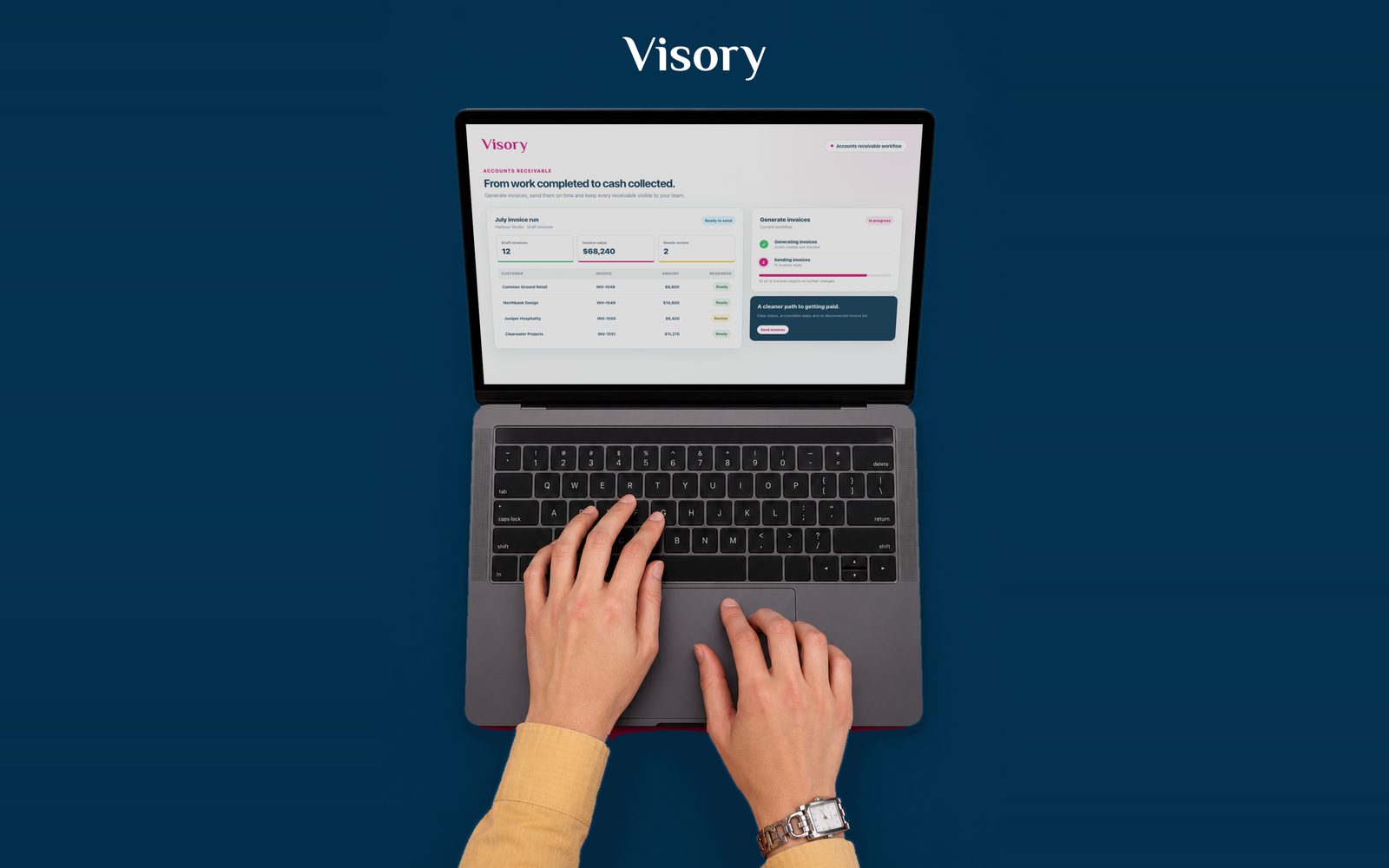
  3. Top-down view of hands on a laptop showing the Visory accounts receivable workflow

    Receive a clear proposal

    A clear commercial proposal for the scope we agree, on one flat monthly fee. No hourly billing. You decide whether to go ahead.

    Flat monthly fee

Get started

The best is ahead for your business.

Start with a discovery call. We will listen first, then show you what your own numbers have been trying to tell you.

Sources (12) · rules last checked October 9, 2026

A different Visory region may suit you

You’re viewing Visory US. Would you like to visit Visory AU?