
2.5x ▼ 0.5 since April
For architecture and design firms
Know which projects earn their fee.
We run your finance function. You get strategic insights. For US architecture and design firms, a dedicated team runs bookkeeping, payroll, accounts payable, and accounts receivable with Delphi AI under their oversight. Once a month, Visory Insights shows which projects are earning their fee, phase by phase, and the one move to make.
- Every phase invoiced to the signed contract, with additional services kept apart until the customer agrees them, so unbilled work is known at each month-end.
- A named Payroll Specialist runs every pay run, checked by Delphi AI before you approve it, with withholding and payroll tax filings prepared from the same run.
- Net multiplier by project every month, briefed by your Business Performance Partner in plain English, with one move to make.


Who this is for
Built for firms that price design by the phase and deliver it by the hour.
If your fees are agreed in a contract, billed phase by phase, and earned by a studio of salaried staff and outside consultants, this is the finance function for it.
- Architecture, interior design, and landscape architecture firms of roughly $750k to $20m in revenue, led by a CEO, president, or founder.
- Fees agreed as fixed fees by phase, by the hour, or as a percentage of construction cost, with additional services along the way.
- A studio of licensed architects and designers on payroll, with engineers, renderers, and other consultants engaged project by project.
- Time kept in a timesheet or project tool, and project returns worked out only when a phase closes.
Anywhere in the United States. Your books stay in your own QuickBooks or Xero file, which you own, and your dedicated team works inside it.
The pressure
Four rules run from the signed contract to the year-end forms.
An architecture firm agrees its fee before the work starts, bills it in phases, and earns it through salaried staff and outside consultants. Federal wage and tax law set two of the rules below for every firm. California’s code shows how a state draws the other two, and architects licensed elsewhere work under their own state’s law.
The contract is the billing schedule.
Phases, the fee basis, and the additional services procedure come from it, so invoices are raised to its terms, and time on work outside it is reported while it is happening, ready to put to the customer.
Set by California Business and Professions Code section 5536.22
An architect in California uses a written contract, signed by both sides before work begins unless the customer knowingly states in writing that work may start sooner. The contract describes the project, the services, the basis of compensation and the method of payment, and the procedure for additional services and for changes to the project, the services, or the fee. It also sets out how either side can end it. Its exceptions include unpaid work, work of the same kind for a customer who has paid for it before, a customer who knowingly states in writing that no such contract is needed, and work for a public agency under that agency’s own contract.
California Business and Professions Code section 5536.22, as amended by Stats. 2019, ch. 376 (SB 608), effective January 1, 2020; California Architects Board, Written contract requirement.Sources California Legislature: BPC 5536.22 California Architects Board: Written contracts
An unpaid design invoice is a dated record with legal weight.
Invoices go out on the contract’s terms and are followed up in your name, so what is owed, and when it fell due, is clear in the ledger. Whether to record a lien is the firm’s decision, with its own legal advisor.
Set by California Civil Code sections 8300 to 8319
In California, a licensed architect, landscape architect, engineer, or land surveyor working under a written contract with the landowner can record a design professional lien on the site when the landowner defaults on payment and construction has not started. A building permit or other government approval using the design work must already be in place, and the landowner gets notice demanding payment at least 10 days before the lien is recorded. The lien is for the contract fee or the reasonable value of the services, whichever is less, after any deposit or prior payment. It expires when construction starts, or after 90 days unless an action to enforce it has begun, and it is not available on an owner-occupied single-family home expected to cost less than $100,000 to build.
California Civil Code sections 8014, 8300, 8302, 8304, 8306, and 8318, added by Stats. 2010, ch. 697 (SB 189), operative July 1, 2012.Sources California Legislature: Civil Code 8302 California Legislature: Civil Code 8304 California Legislature: Civil Code 8306 California Legislature: Civil Code 8318
A job title does not make a designer exempt.
Your Payroll Specialist records each role as exempt or nonexempt as you set it, and overtime for nonexempt staff, by the week and by the day where state law sets a daily limit, is paid in the same run.
Set by Fair Labor Standards Act; 29 CFR 541.301 and 541.600
Unless exempt, an employee covered by the Fair Labor Standards Act is paid at least time and one-half for hours over 40 in a workweek. The learned professional exemption needs a primary duty requiring advanced knowledge in a field of science or learning, which the regulations say includes architecture, and a salary of at least $684 a week. It does not apply to occupations in which most employees gained their skill by experience, or that can customarily be done with knowledge acquired through an apprenticeship. States can go further: in California, a nonexempt employee is also owed overtime after eight hours in a workday, and an exempt professional earns a monthly salary of at least twice the state minimum wage for full-time work.
Fair Labor Standards Act, section 7(a); 29 CFR 541.301 (learned professionals); 29 CFR 541.600 (amount of salary required), as amended by 91 FR 27835, May 15, 2026; California Labor Code section 515(a) and (c), as amended effective January 1, 2013; California Labor Commissioner’s Office, Overtime FAQ.Sources eCFR: 29 CFR 541.301 eCFR: 29 CFR 541.600 California Legislature: Labor Code 515 California Labor Commissioner: Overtime
Every consultant payment counts toward a January form.
Bills from engineers, renderers, and freelance drafters are coded to the consultant as they are paid, so each year-end total is already in the ledger when the forms are due.
Set by Form 1099-NEC; Public Law 119-21
For tax years beginning after 2025, a business files Form 1099-NEC for each person it paid at least $2,000 during the year for services by someone who is not its employee, with the threshold open to inflation adjustment from 2027. The form goes to the consultant and to the IRS by January 31. Payments to a corporation are generally not reported. A consultant who has not given you a correct taxpayer identification number is subject to backup withholding at 24%.
Internal Revenue Service, Instructions for Forms 1099-MISC and 1099-NEC (Rev. December 2026), threshold raised by Public Law 119-21 for tax years beginning after 2025; Internal Revenue Code section 6071(c); Internal Revenue Service, Backup withholding.Sources IRS: Instructions for Forms 1099-MISC and 1099-NEC IRS: Backup withholding
Every instrument named here is listed with its effective date at the foot of this page.
How much of last quarter’s design time went on changes nobody agreed to pay for? Start with a discovery call. A senior member of the Visory team then runs the free financial health check on your own numbers, before anything is agreed.
Book a discovery callWhat we run for architecture firms
From accurate processing to leadership confidence.
Visory Insights leads. The basics underneath it make it trustworthy and free your team for the work that matters, run by a dedicated team with Delphi AI under their oversight.Flat monthly fee. No hourly billing.
- 1 Accurate processing Bookkeeping and payroll done right, every month.
- 2 Clean, reliable data The foundation that makes reporting defensible.
- 3 Meaningful insights Cash, margin, and the year ahead, explained.
- 4 Leadership confidence You present numbers you trust. The plan gets backed.
The leading service
Visory Insights
Net multiplier, utilization, unbilled work, and days sales outstanding (DSO), explained once a month with one move to make. A named partner who walks your leadership team through project returns before the next fee proposal is priced or the next hire is made.
See how Visory Insights works- Monthly plain-English report
- Structured session with your leadership team
- Twelve-month forward view of cash
- A named Business Performance Partner
The basics underneath it
Bookkeeping
Fees, reimbursable costs, and consultant bills coded by project and phase, with costs you rebill tracked until they reach an invoice.
Explore bookkeepingPayroll
Salaried and hourly staff paid on schedule, overtime checked for nonexempt roles, and withholding and filings prepared from the same run.
See how payroll runsAccounts payable
Engineering, rendering, printing, and model-making bills captured, coded to the project they served, and paid when you approve.
See accounts payableAccounts receivable
Phase, hourly, and additional services invoices raised to the contract’s terms, and followed up in your name.
See accounts receivableOvertime status, contractor calls, contracts, and liens stay with your firm and its advisors. Visory keeps the records those calls rest on: who you employ and engage, the hours and fees on each project, and what is owed to you. It does not decide whether a role is exempt from overtime, whether a consultant is an employee, what your contracts must say, or whether to record a lien.
Visory Insights for architecture firms
One month of Visory Insights on an architecture firm’s numbers.
Reports tell you what happened. Visory Insights tells you what it means, and what to do about it. Here is September for Alder Row Architects, a fictional architecture and interiors firm with about $5m a year in net fees and 28 people.
Net fees held at about $420k a month, and the studio is busier than it was in April. The extra hours went on design changes no customer has yet agreed to pay for. September charged $168k of direct labor to projects, $28k more than April, and earned the same fees.
Change time not yet agreed, at cost $64k At Risk $44k past the $20k the firm lets build before an additional services agreement is signed: design changes on three projects since June, none yet put to the customer
Net multiplier Agreeing September’s $28k of change time as $84k of additional services, at the 3.0x target, takes the month from 2.5x to 3.0x
Put additional services agreements to the three customers this week, and pause out-of-scope work on each project until its agreement is signed. The change time on each project, set against its contract, is listed and the invoices are drafted, ready for your approval at the session.
≈ $84k of September fees to agree Insight session Accepted 9:00 to 9:45am · Video call  With your Business Performance Partner
Prepared and checked by Delphi AI, and briefed by your Business Performance Partner in plain English, ahead of your next session.
- Monthly plain-English report
- Structured insight sessions
- Net multiplier and utilization, project by project
Which of your projects is running past its fee? A discovery call is a conversation about how you price projects, how you bill phases, and the numbers you want in front of you each month.
Book a discovery callFits your stack
Works with the tools you already use.
Your ledger and your payroll stay where they are. Visory connects to them and keeps the data flowing every day, so your team and Delphi are working from current numbers.
Accounting and books
Where your ledger and reporting live.


Payroll and people
Pay runs, payroll tax withholding and filings, and the people behind them.


Timesheet and project tools
Projects, phases, fees, and timesheets stay in the tool your studio already runs, whether Harvest or another. Visory works from its time and project reports at each month-end.
Resources for architecture firms
Content written for architecture firms by the expert teams at Visory.



Common questions
Straight answers for architecture firms.
The questions architecture firm CEOs, presidents, and founders ask before they hand Visory the finance function. The general ones are on the common questions page.
How do you handle phase billing for architecture projects?
Each project is set up from its contract: the phases, the fee for each, and whether the fee is fixed, hourly, or a percentage of construction cost. When a phase is reached, or on the dates the contract sets, the invoice is prepared, you approve it, and it goes out in your name and is followed up until it is paid.
Can you track work in progress against each project fee?
Yes. At each month-end, hours and costs are read from your timesheet or project tool and set against the fee for the phase underway, so you see which projects have used more of their fee than the work completed, and which phases are finished but not yet invoiced. Both come to the top of the monthly read, with unbilled work listed by age.
How do you handle additional services and design changes?
Time recorded on work outside the contract is kept apart from the phase it sits in and listed by project each month, so a change the customer asked for becomes additional services to agree, not a loss found when the phase closes. Once the customer signs, it is invoiced on the terms the agreement sets.
What is a net multiplier, and why report it?
It is net fees earned divided by the direct labor cost of the time charged to projects: what each dollar of project salary brings back in fees. It falls when hours go on work nobody is paying for, such as design changes never agreed, and it shows that while the project is still running. Visory reports it every month, project by project, from your timesheets and the ledger.
Do salaried architects get paid overtime?
Possibly. Under the Fair Labor Standards Act, an employee who is not exempt is paid at least time and one-half for hours over 40 in a workweek. An architect can be exempt as a learned professional when their primary duty requires advanced knowledge in a field of science or learning, which the regulations say includes architecture, and they are paid a salary of at least $684 a week. States can add their own rules: in California, overtime is also due after eight hours in a workday, and an exempt professional earns at least twice the state minimum wage for full-time work. Your Payroll Specialist records each role’s status as you set it, and Delphi AI checks every run against it. This is general information, not legal advice.
Is our long-term freelance drafter actually an employee?
It may be. For federal employment taxes, the IRS looks at who controls how the work is done, who controls the business side of it, and how the relationship is set up. Under federal wage law, the question is whether the person depends on your firm for work or is in business for themself. That call is yours, with legal advice, and nothing here is legal advice. Visory shows how long each freelancer has worked with you, how often, and at what cost, which is usually where the question starts.
Which consultants need a Form 1099-NEC?
For tax years beginning after 2025, a business files Form 1099-NEC for each person it paid at least $2,000 during the year for services by someone who is not its employee, and the form goes to the consultant and to the IRS by January 31. Payments to a corporation are generally not reported. A consultant who has not given you a correct taxpayer identification number is subject to backup withholding at 24%. Visory codes consultant payments to the consultant as they are paid, so each total is in the ledger at year-end. Whether a payment is reportable is a tax question, and this is not tax advice.
Does an architect need a written contract before starting work?
In California, generally yes. The Business and Professions Code requires a written contract, signed before work begins unless the customer knowingly states in writing that work may start sooner, describing the project, the services, the basis of compensation and method of payment, and how additional services and changes will be handled. Architects licensed in other states work under their own state’s law. Visory sets up each project’s billing from the contract you sign and keeps work outside it apart. What your contracts must say is a question for your legal advisor, and this is general information, not legal advice.
How much does Visory cost?
Visory charges one flat monthly fee for the scope we agree. No timesheets, no hourly billing, no surprises. The fee reflects the services you take and the volume of work in your firm, from the size of the pay run to the number of project invoices and consultant bills each month, so you know the monthly cost before you start.
See how pricing works More questions, longer answers. Every question has its own link. See all common questions
General information for architecture firms, not financial or tax advice.
Getting started
Start with clarity, not a contract.
Three steps, in whatever rhythm suits you. Each one is useful on its own.
-

Book a discovery call
An obligation-free conversation about how your firm prices projects, bills phases, and what you want the numbers to show.
Obligation-free -

Get your free financial health check
A senior member of the Visory team analyzes your financials and shows where your finance function can improve. See the clarity before you commit to anything.
Free · your own numbers -
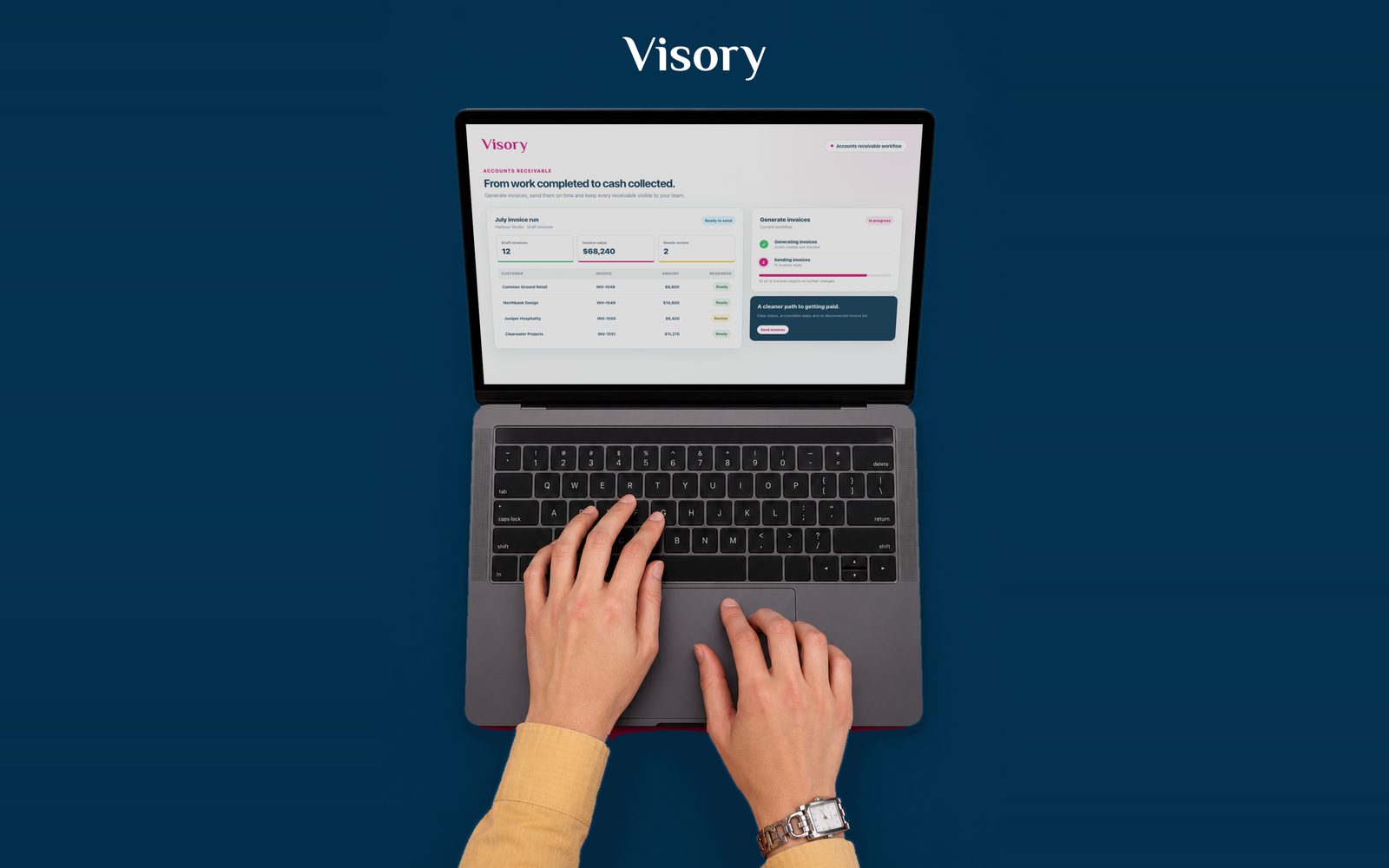
See how Visory works in practice
A walkthrough of the books, the pay run, and the monthly read for a firm like yours. If it fits, we agree a flat monthly scope.
Flat monthly fee
Get started
Price the next project on what the last one really took.
Start with a discovery call. Then a senior member of the Visory team runs the free financial health check on your own numbers and shows you where design time stops short of an invoice.
Sources (6) · rules last checked October 8, 2026
- California Business and Professions Code section 5536.22: written contract executed before work begins, its required contents, including the procedure for additional services and changes, and its exceptions; as amended by Stats. 2019, ch. 376 (SB 608), effective January 1, 2020; California Architects Board, Written contract requirement.
- California Civil Code sections 8014 (design professional), 8300, 8302 (lien on the site, its amount, and the permit or approval requirement), 8304 (default, and notice at least 10 days before recording), 8306 (expiry on commencement of work or after 90 days), and 8318 (owner-occupied single-family residences under $100,000), added by Stats. 2010, ch. 697 (SB 189), operative July 1, 2012.
- Fair Labor Standards Act, section 7(a): overtime at not less than time and one-half for hours over 40 in a workweek; 29 CFR 541.300 and 541.301, learned professionals, with architecture named among the fields of science or learning; 29 CFR 541.600, salary of not less than $684 a week, as amended by 91 FR 27835, effective May 15, 2026.
- California Labor Code section 515(a) and (c): exempt executive, administrative, and professional employees earn a monthly salary of no less than two times the state minimum wage for full-time employment of 40 hours a week, as amended by Stats. 2012, ch. 820, effective January 1, 2013; California Labor Commissioner’s Office, Overtime FAQ: overtime after eight hours in a workday or 40 hours in a workweek.
- Internal Revenue Service, Independent contractor (self-employed) or employee?: behavioral control, financial control, and type of relationship, page reviewed May 19, 2026; 29 CFR part 795, Employee or Independent Contractor Classification Under the Fair Labor Standards Act (89 FR 1638), effective March 11, 2024; U.S. Department of Labor, Wage and Hour Division, Field Assistance Bulletin 2025-1, issued May 1, 2025; proposed rule, Employee or Independent Contractor Status Under the Fair Labor Standards Act, 91 FR 9932, published February 27, 2026.
- Internal Revenue Service, Instructions for Forms 1099-MISC and 1099-NEC (Rev. December 2026): $2,000 threshold for tax years beginning after 2025 under Public Law 119-21, filing and furnishing by January 31 under Internal Revenue Code section 6071(c); Internal Revenue Service, Backup withholding, at 24%, page reviewed June 28, 2026.